
On this page
- Roof area, roofing squares, and bundles: the basics
- How to measure your roof area
- How roof pitch changes the area
- How many bundles of shingles are in a square?
- How much shingle waste should you allow?
- Worked example: projected area with a 6/12 pitch
- Short example: directly measured roof planes
- Bundle comparison by roof area and product coverage
- Calculate starter, ridge caps, and accessories separately
- Material-order checklist before you buy
- Manufacturer references
What you need to know
To calculate how many shingles you need, divide the actual sloped roof area, including a waste allowance, by the selected product’s coverage per bundle, then round up. The three key inputs are roof surface area, verified bundle coverage, and an appropriate waste allowance.
This guide is for North American asphalt-shingle estimates. It uses feet, square feet, roofing squares, and rise-over-12 pitch notation, with selected metric equivalents for reference.
Required bundles = (Actual roof area × (1 + waste percentage)) ÷ Coverage per bundle, rounded up to the next whole bundle. Use square feet for both area and bundle coverage, and enter waste as a decimal: 10% = 0.10. Keep intermediate figures unrounded.
In Excel or Google Sheets, if A2 contains actual roof area, B2 contains waste as 10% or 0.10, and C2 contains coverage per bundle, use =ROUNDUP(A2*(1+B2)/C2,0).
Use the Calcavera Roofing Shingle Calculator alongside the measurement and product-coverage checks below.
Roof area, roofing squares, and bundles: the basics
A roof estimate uses several different measurements. Keeping them separate prevents most quantity errors.
- Horizontal projected area: the roof’s footprint viewed straight down, including its overhangs. It does not include the extra surface created by slope.
- Actual roof surface area: the combined sloped area of all roof planes receiving shingles.
- Roofing square: a unit of area equal to 100 square feet, or approximately 9.2903 square meters.
- Bundle: a package of shingles. Its installed coverage depends on the product.
Never assume the home’s interior floor area equals its roofing area. A two-story house, for example, has floor area on more than one level, while the roof covers a different footprint. Garages, porches, additions, eaves, and roof slope also affect the estimate.
Roofing squares = Actual roof surface area in square feet ÷ 100.
A roof with 1,600 square feet of actual surface area contains 16 roofing squares before waste. This does not mean it requires 16 bundles.
How to measure your roof area
Start with a roof sketch. Label each plane, note its shape and pitch, and record all dimensions in the same units. Use a consistent measurement method: either horizontal projected dimensions with pitch adjustments, or dimensions measured directly along each roof plane.
Do not climb onto a roof solely to obtain an estimate. If dimensions cannot be obtained safely from plans, accessible measurements, or a suitable roof measurement report, have a roofing professional measure it.
Simple gable roof
A simple gable roof has two main sloping planes. You can estimate it in either of two ways:
- Using horizontal dimensions: measure the roof’s projected length and total projected width, including eave and gable-end overhangs. Multiply length by width. If both slopes have the same pitch, multiply the total projected area by that pitch’s multiplier.
- Using roof-plane dimensions: multiply each plane’s length parallel to the ridge by its sloped distance from eave to ridge. Add the two plane areas. Do not apply a pitch multiplier afterward.
If the two sides have different pitches, calculate their projected areas and pitch adjustments separately. Do not assume the ridge divides the roof into equal halves.
Shed roof
A simple shed roof has one sloping plane. For projected measurements, multiply the horizontal roof length by the horizontal width, including overhangs, then apply its pitch multiplier.
If you have the plane’s actual sloped length and its perpendicular roof width, multiply those directly. The resulting surface area already includes slope.
Multi-plane roofs, hips, and dormers
Break a complicated roof into individual rectangles, triangles, and trapezoids. Use these area formulas, with all dimensions taken in the same measurement plane:
- Rectangle: length × width.
- Triangle: base × perpendicular height ÷ 2.
- Trapezoid: (parallel side 1 + parallel side 2) × perpendicular distance between them ÷ 2.
For projected shapes, apply each plane’s pitch multiplier before adding the results. For roof-surface dimensions, add the areas directly.
Include separate garage, porch, addition, and dormer roof sections that will receive shingles. Where a dormer interrupts a larger roof plane, avoid counting the hidden or replaced portion of that plane as well as the dormer roof. Dormer walls are not roof area.
Make sure the sketch includes the outer roof edges, not just exterior wall dimensions. Eave and gable-end overhangs can otherwise disappear from the estimate.
How roof pitch changes the area
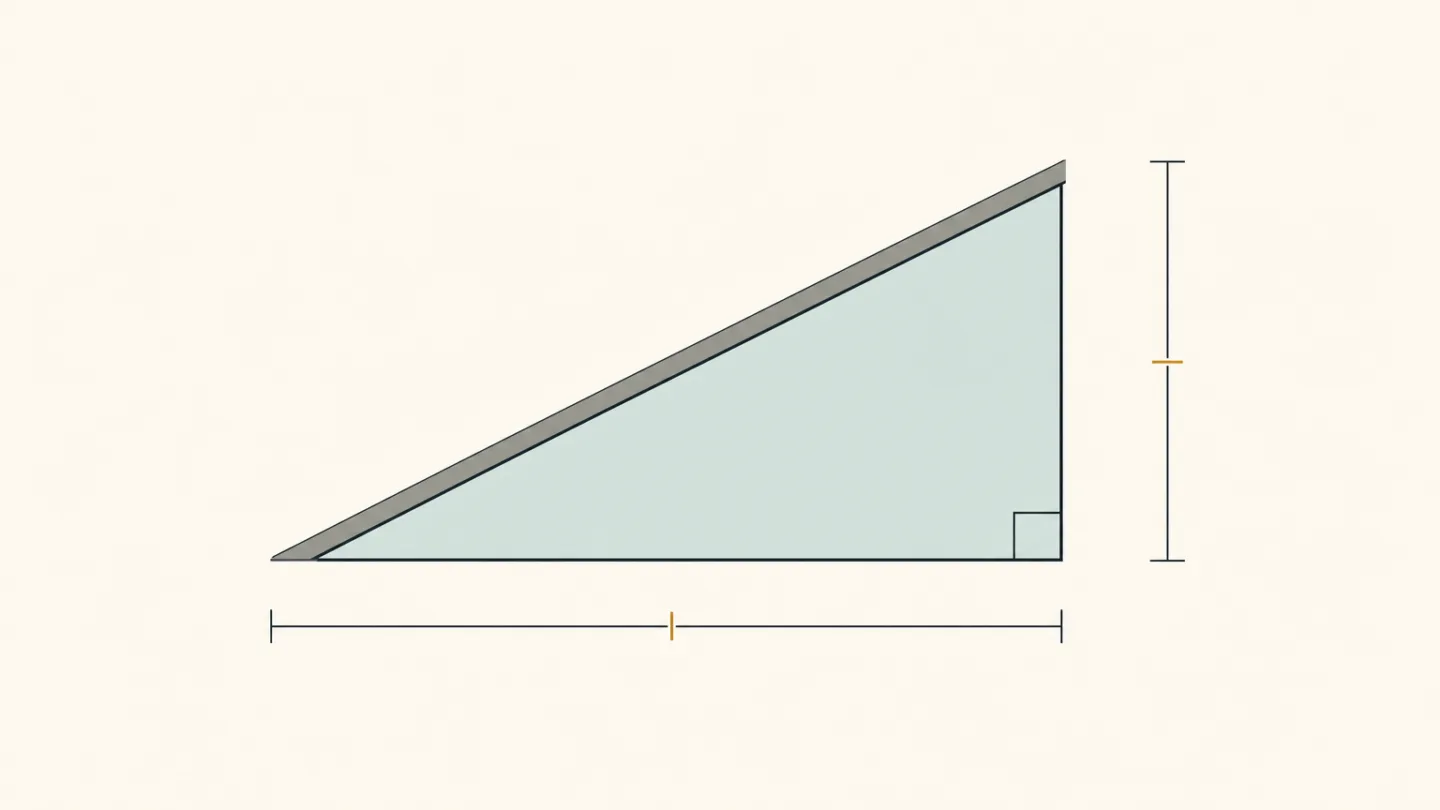
Roof pitch describes vertical rise over horizontal run, commonly expressed over a 12-inch run. A 6/12 pitch rises 6 inches for every 12 inches of horizontal travel—approximately 152 mm over 305 mm. It does not mean a 6-inch rise over 12 inches measured along the slope.
The pitch multiplier converts horizontal projected area into sloped surface area:
Roof pitch multiplier = √[1 + (rise ÷ run)²].
For a 6/12 roof:
√[1 + (6 ÷ 12)²] = √1.25 ≈ 1.118.
Then calculate:
Actual roof surface area = Horizontal projected area × Roof pitch multiplier.
| Pitch | Approximate multiplier |
|---|---|
| 3/12 | 1.031 |
| 4/12 | 1.054 |
| 6/12 | 1.118 |
| 8/12 | 1.202 |
| 12/12 | 1.414 |
How many bundles of shingles are in a square?
Many standard asphalt-shingle products cover one roofing square with three bundles. Some products require four or five, as explained in IKO’s guide to bundle coverage. Verify the selected product’s stated coverage on its packaging or current manufacturer documentation.
Coverage per bundle in square feet = 100 ÷ Bundles per square.
| Verified product coverage | Equivalent coverage per bundle |
|---|---|
| 3 bundles per 100 sq ft | 33⅓ sq ft, approximately 3.097 m² |
| 4 bundles per 100 sq ft | 25 sq ft, approximately 2.323 m² |
| 5 bundles per 100 sq ft | 20 sq ft, approximately 1.858 m² |
The number of individual shingles in a bundle is not enough to calculate coverage unless you also know the product’s installed exposure and layout. Use the manufacturer’s coverage figure rather than the shingle count or the combined physical area of loose shingles.
When coverage is given as bundles per square, multiply the area including waste by bundles per square ÷ 100, then round up. For a product rated at three bundles per 100 square feet, multiplying by 3 ÷ 100 avoids errors caused by shortening bundle coverage to 33.3 square feet.
How much shingle waste should you allow?
10–15% is a common preliminary estimating range for asphalt-shingle waste, not a guaranteed allowance for every roof; see IKO’s estimating guidance. Waste accounts for material lost through trimming and layout.
- Simple roof geometry: long, uninterrupted planes generally offer fewer cutting complications.
- Hips, valleys, and dormers: intersections and short roof sections can create more cuts and less reusable material.
- Product and installation layout: shingle dimensions, required offsets, and valley details affect usable coverage and offcuts.
Use the roof layout and product instructions to refine the allowance with the installer or supplier. Complex roofs may require a different percentage.
If you want unopened bundles left for future repairs, identify that as a separate spare-material allowance rather than hiding it within cutting waste.
Worked example: projected area with a 6/12 pitch
Assume a roof has a horizontal projected area of 1,200 square feet, including overhangs, and all planes have a 6/12 pitch. Use a 10% waste allowance and verified product coverage of 100 square feet per three bundles.
- Convert projected area to actual surface area: 1,200 × 1.118 ≈ 1,341.6 square feet, or approximately 124.6 m².
- Convert to roofing squares: 1,341.6 ÷ 100 = 13.416 squares before waste.
- Add 10% waste: 1,341.6 × 1.10 = 1,475.76 square feet of estimated ordering area.
- Convert to bundles: 1,475.76 × 3 ÷ 100 = 44.2728 bundles.
- Round up: order 45 bundles of field shingles under these assumptions.
The calculation uses the rounded pitch multiplier of 1.118. Retaining more precision gives a slightly different intermediate area but the same 45-bundle result.
Short example: directly measured roof planes
Suppose two rectangular roof planes have dimensions measured along their surfaces:
- Plane A: 30 ft × 20 ft = 600 sq ft.
- Plane B: 30 ft × 16 ft = 480 sq ft.
The combined actual roof area is 1,080 square feet, approximately 100.3 m². No pitch adjustment is needed.
Using a 12% waste allowance and example coverage of three bundles per square:
1,080 × 1.12 = 1,209.6 sq ft; 1,209.6 × 3 ÷ 100 = 36.288 bundles; round up to 37 bundles.
Bundle comparison by roof area and product coverage
The table below starts with actual sloped roof area and includes 10% waste. Each result is rounded up to a whole bundle. It covers field shingles only.
| Actual roof area | Ordering area with 10% waste | 3 bundles per square | 4 bundles per square | 5 bundles per square |
|---|---|---|---|---|
| 1,000 sq ft | 1,100 sq ft | 33 bundles | 44 bundles | 55 bundles |
| 1,200 sq ft | 1,320 sq ft | 40 bundles | 53 bundles | 66 bundles |
| 1,500 sq ft | 1,650 sq ft | 50 bundles | 66 bundles | 83 bundles |
| 2,000 sq ft | 2,200 sq ft | 66 bundles | 88 bundles | 110 bundles |
| 2,500 sq ft | 2,750 sq ft | 83 bundles | 110 bundles | 138 bundles |
These coverage columns describe different product assumptions, not interchangeable packaging choices. Use only the column matching the selected product’s verified coverage.
Calculate starter, ridge caps, and accessories separately
Field-shingle area is only one part of a roofing material order. A field-shingle waste allowance does not automatically supply starter or ridge materials. Other components use different coverage units and installation details.
- Starter shingles: measure eave lengths and any rake edges requiring starter under the selected roofing system’s instructions. Divide the required linear footage by the product’s stated installed linear coverage, allow for cuts, and round up.
- Hip-and-ridge caps: measure all hips and ridges receiving caps in linear feet. Use the cap product’s installed coverage, which accounts for its exposure and overlap.
- Underlayment: estimate separately using roof area, required laps, and the roll’s usable coverage. A roll’s nominal area is not necessarily its installed coverage.
- Flashing and edge materials: measure the relevant eaves, rakes, valleys, wall intersections, and penetrations. Quantities depend on the selected details and overlaps.
- Other accessories: identify vents, fasteners, and any specified membranes or related components separately, following the chosen system’s instructions.
Record ridge and eave lengths in linear feet, not square feet; 1 linear foot is 0.3048 meters. Do not assume leftover field shingles are suitable for starter or caps unless the manufacturer permits that use for the selected product.
Material-order checklist before you buy
- Compare the roof sketch with the replacement scope to confirm no sections are omitted or counted twice.
- Confirm the exact product and color for each section; calculate different products separately.
- Check the takeoff against the measurement, coverage, waste, and accessory guidance above.
- Have the installer or supplier review quantities, packaging, and any planned spare bundles before purchasing.
Manufacturer references
For further estimating guidance, consult these manufacturer guides. The current documentation for your exact selected product remains the source for its coverage.
- IKO Industries — How Many Square Feet in a Bundle of Shingles: roofing squares, pitch conversion, bundle coverage variations, and preliminary waste allowances.
- Owens Corning — DIY Roofing: Re-Roofing Tips: measuring roof planes, converting area to squares and bundles, allowing for trimming waste, and distinguishing shingles from underlayment.
Frequently asked questions
How many bundles of shingles are in a roofing square?
Three is common, but some products require four or five. One roofing square is 100 square feet; check the selected product’s stated installed coverage.
How do I calculate how many shingles I need?
Multiply actual sloped roof area by 1 plus the waste allowance, divide by coverage per bundle, and round the final result up to a whole bundle.
Can I use my home’s floor area to estimate shingles?
Not directly. Interior floor area does not account for roof slope, overhangs, garages, porches, or separate roof sections. Use roof measurements instead.
Do I apply a pitch multiplier to measurements taken along the roof slope?
No. Roof-plane measurements already include slope. The multiplier is only for horizontal projected area.
How much waste should I allow for roof shingles?
Use 10–15% as a preliminary range, then have the installer or supplier refine it for the roof layout and product instructions.
How many bundles are needed for a 1,200-square-foot roof?
With 10% waste and verified coverage of three bundles per square, 1,200 square feet of actual sloped area requires 40 bundles. If that figure is instead horizontal projected area for a 6/12 roof, the estimate is 45 bundles.