
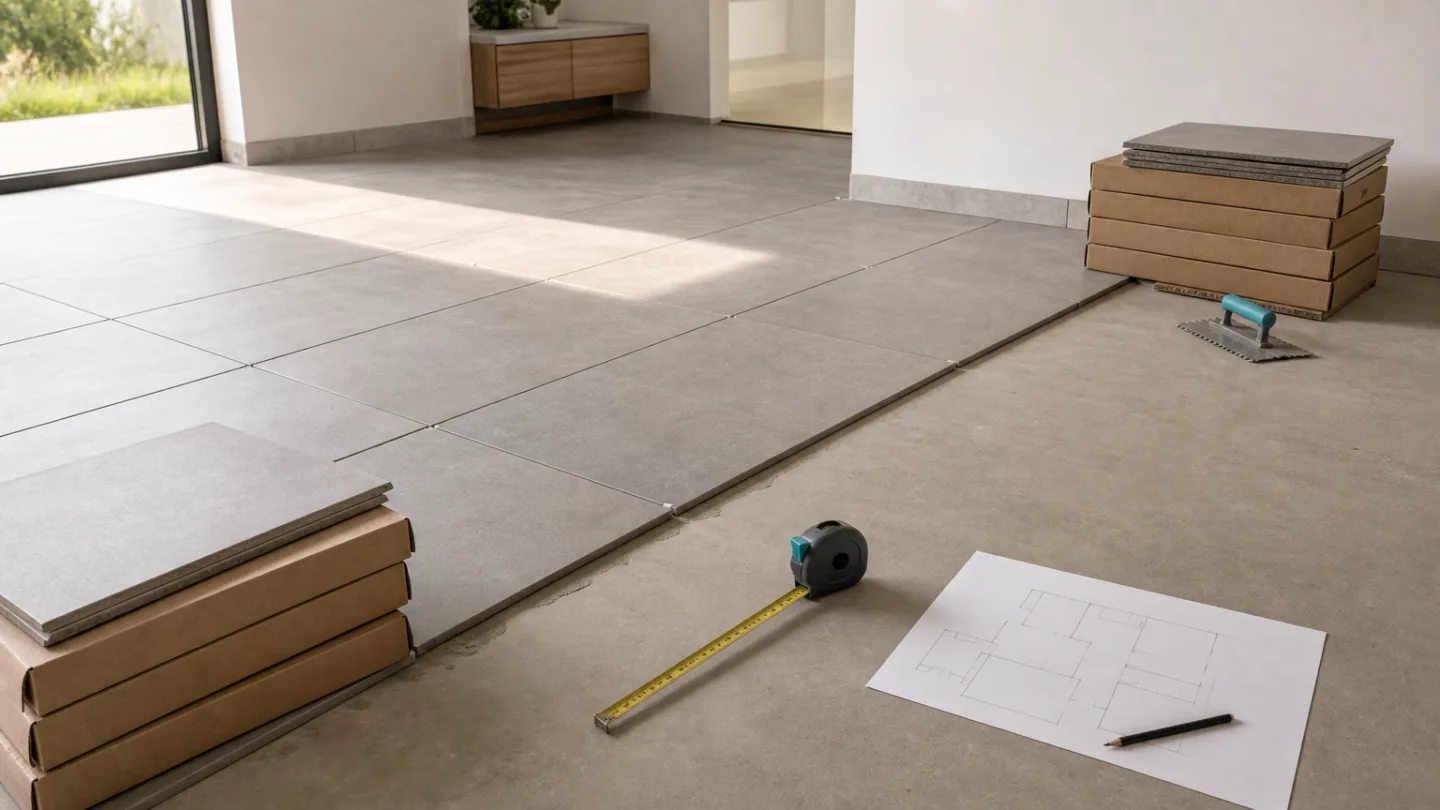
To answer “How many tiles do I need?”, start with the area you want to cover—not the room’s perimeter. Divide that area by the area of one tile, add an allowance appropriate to your layout, and round up to the quantity you can actually buy.
This guide explains how to calculate tiles for floors and walls, including metric and imperial examples, openings, irregular rooms, box coverage, and material costs. Use Calcavera’s Tile Quantity and Cost Calculator to check the arithmetic once you have your measurements and product details.
The tile calculation at a glance
- Measure every surface that will be tiled.
- Calculate the total area, subtracting untiled openings where appropriate.
- Calculate the area of one tile using compatible units.
- Divide the net installation area by the tile area.
- Add a waste allowance based on the layout and project conditions.
- Round up to whole tiles or complete boxes.
- Apply the supplier’s price to the rounded purchase quantity.
Required tiles = round up [(net area ÷ tile area) × (1 + waste allowance)]
Use the allowance as a decimal: 5% becomes 0.05, 10% becomes 0.10, and 15% becomes 0.15. These are illustrative choices, not fixed installation rules.
This formula is an area-based estimate. It does not determine exactly how many cuts, usable offcuts, or pattern pieces a particular layout requires.
1. Measure the installation area
Rectangular floors and walls
For a rectangular floor, measure its length and width. For a rectangular wall, measure its width and the height you intend to tile.
Rectangle area = length × width
A 4 m × 5 m floor has an area of 20 m². A 12 ft × 10 ft room has an area of 120 sq ft. Measure the actual installation boundaries rather than assuming that the entire room or wall will receive tile.
Irregular rooms
Divide an L-shaped room or another irregular surface into non-overlapping rectangles or simple sections. Calculate each section separately, then add the results.
For example, two sections measuring 3 m × 4 m and 2 m × 2 m total 12 + 4 = 16 m². Make sure the sections cover the intended surface without double-counting any overlap.
For shapes that cannot be represented by rectangles, use the appropriate area formula or take more detailed measurements. Record each section on a sketch so the calculation can be checked.
Doors, windows, and other exclusions
For wall tiling, subtract doors and windows that will not receive tile:
Net wall area = gross wall area − untiled opening area
If you will tile window reveals, door returns, or niche interiors, measure those additional surfaces and add them separately. On floors, subtract only areas that are genuinely outside the planned installation—not automatically every area occupied by furniture or fittings.
Small exclusions may not reduce the final order because cuts around them still consume material, and tiles may only be available in full boxes.
2. Put all measurements into compatible units
The installation area and tile area must use the same square units before you divide them. You cannot divide square meters by square centimeters and treat the result as a tile count without conversion.
| Conversion | Relationship |
|---|---|
| Centimeters to meters | 100 cm = 1 m |
| Millimeters to meters | 1,000 mm = 1 m |
| Inches to feet | 12 in = 1 ft |
| Square centimeters to square meters | 10,000 cm² = 1 m² |
| Square millimeters to square meters | 1,000,000 mm² = 1 m² |
| Square inches to square feet | 144 sq in = 1 sq ft |
| Square feet to square meters | 1 sq ft = 0.09290304 m² |
The simplest approach is usually to convert tile dimensions into the units used for the room, then multiply.
- A 60 cm × 60 cm tile is 0.60 m × 0.60 m, giving 0.36 m² per tile.
- A 600 mm × 600 mm tile also gives 0.36 m² per tile.
- A 12 in × 24 in tile is 1 ft × 2 ft, giving 2 sq ft per tile.
Linear and area conversions are different. Dividing a measurement in centimeters by 100 converts a length to meters; dividing an area in square centimeters by 100 does not convert it to square meters.
3. Calculate tile area and the base quantity
For a square or rectangular tile:
Tile area = tile length × tile width
Then calculate the quantity before waste:
Base tile quantity = net installation area ÷ tile area
Keep decimal results during the calculation. Apply the allowance before rounding up so repeated rounding does not unnecessarily increase the estimate.
For mosaics sold on sheets, use the stated sheet or box coverage. For mixed-size patterns, calculate the required pattern sets or quantities of each size rather than dividing the entire project by the area of just one tile.
Product dimensions may be nominal rather than exact. Grout joints and actual tile dimensions affect the layout, so use the manufacturer’s stated coverage when purchasing by area and check the planned layout separately. Do not simply enlarge the tile dimensions by an assumed joint width to reduce your order.
4. Choose a project-specific waste allowance
Waste allowance covers material used or lost through cuts, unusable offcuts, and possible breakage. You may also choose to keep spare tiles for future repairs.
A straightforward rectangular installation with a straight-lay layout usually requires less extra material than a diagonal layout, a complex pattern, or an irregular room. Large tiles in a small space, many corners, numerous openings, and limited opportunities to reuse offcuts can also affect the quantity.
| Illustrative allowance | How to use it |
|---|---|
| 5% | Compare as a lower-allowance scenario where the layout is simple and cuts are limited. |
| 10% | Use as another estimating scenario, then check it against the actual cut plan. |
| 15% | Compare for a more demanding layout; some projects may need a different allowance. |
None of these percentages guarantees enough material. For a complex pattern or expensive tile, ask the supplier or installer to review the layout before ordering.
Buying the intended quantity together may help avoid later batch-matching difficulties, although appearance and matching depend on the product. If you need spare tiles, decide whether they are included in the allowance or added separately so you do not count them twice.
5. Round up to full tiles or boxes
You cannot normally purchase a fraction of a tile or box. Always round the required purchase quantity up, not down.
Boxes required = round up [(net area × (1 + allowance)) ÷ stated box coverage]
If the product lists tiles per box, you can instead divide your unrounded tile requirement by that count and round up to complete boxes.
Box coverage varies. It depends on the product’s dimensions, tile count, and packaging. Always check the packaging or supplier specifications; do not assume that every box covers the same area.
Full-box rounding may provide extra material beyond your chosen allowance. Keep track of both the required quantity and the quantity you will actually receive.
Worked example: 4 m × 5 m floor with 60 cm tiles
This example uses an illustrative 10% allowance and a hypothetical pack containing four tiles. Verify your own product’s packaging before ordering.
| Step | Calculation | Result |
|---|---|---|
| Floor area | 4 × 5 | 20 m² |
| Tile area | 0.60 × 0.60 | 0.36 m² |
| Base quantity | 20 ÷ 0.36 | 55.56 tiles approximately |
| With allowance | (20 ÷ 0.36) × 1.10 | 61.11 tiles approximately |
| If sold individually | Round up | 62 tiles |
| If sold four per box | Round up 61.11 ÷ 4 | 16 boxes |
Sixteen four-tile boxes contain 64 tiles, with a calculated tile-face area of 23.04 m². The boxes provide more than the 22 m² allowance-adjusted target because the order must be rounded up.
Worked example: 12 ft × 10 ft room with 12 in × 24 in tiles
Convert the tiles to feet first: 12 in = 1 ft and 24 in = 2 ft.
- Room area: 12 × 10 = 120 sq ft.
- Tile area: 1 × 2 = 2 sq ft.
- Base quantity: 120 ÷ 2 = 60 tiles.
- With an illustrative 10% allowance: 60 × 1.10 = 66 tiles.
If this example product comes in eight-tile boxes, round up 66 ÷ 8 = 8.25 to 9 boxes. That provides 72 tiles, or 144 sq ft of calculated tile-face area.
Rotating a rectangular tile does not change its area, but it can change the cuts and offcut reuse. A floor tile calculator provides an area estimate; the orientation and pattern still need a layout check.
Worked example: wall tiles with a door and window
Suppose a wall measures 3 m wide × 2.4 m high. It has an untiled door measuring 0.9 m × 2.1 m and an untiled window measuring 1.2 m × 0.6 m. This example does not include tiled reveals or returns.
- Gross wall area: 3 × 2.4 = 7.20 m².
- Door area: 0.9 × 2.1 = 1.89 m².
- Window area: 1.2 × 0.6 = 0.72 m².
- Net wall area: 7.20 − 1.89 − 0.72 = 4.59 m².
For 30 cm × 60 cm tiles, each tile has an area of 0.30 × 0.60 = 0.18 m².
The base quantity is 4.59 ÷ 0.18 = 25.5 tiles. With an illustrative 10% allowance, the result is 28.05 tiles, rounded up to 29 individual tiles.
If the product is sold in six-tile boxes, you would order five boxes containing 30 tiles. Check the cuts around the openings before accepting the allowance: subtracting opening area does not remove the need for surrounding cut pieces.
6. Estimate tile material cost
Use the supplier’s pricing unit and your rounded purchase quantity. Charging only for the bare installation area can underestimate the invoice when waste and full boxes increase the order.
| Price basis | Cost calculation | Using the examples above |
|---|---|---|
| Per tile | Purchased tiles × price per tile | 62 × the tile price for the metric floor, if sold individually |
| Per box | Purchased boxes × price per box | 16 × the box price for the metric floor |
| Per square foot | Billed square feet × price per sq ft | 144 × the area price for the nine-box imperial order, if billed on that coverage |
| Per square meter | Billed square meters × price per m² | 23.04 × the area price for the 16-box metric order, if billed on that coverage |
Use the supplier’s stated pack coverage and billing basis for the final quote. An advertised price per square meter or square foot may still require buying complete boxes; confirm whether the displayed rate includes applicable taxes.
A tile cost calculator estimates tile material cost, not necessarily the complete installed project. Depending on the project and location, additional costs may include:
- Adhesive, grout, and spacers.
- Trims, edge pieces, and other accessories.
- Delivery and handling.
- Surface preparation and removal of existing finishes.
- Labor and applicable taxes.
Installation requirements depend on the tile type, substrate, environment, manufacturer instructions, and local standards. An area calculation alone cannot determine the appropriate adhesive, preparation, or waterproofing system.
Common tile calculation mistakes
- Mixing centimeters and meters: convert dimensions before calculating tile area.
- Using perimeter instead of area: perimeter measures the boundary, not the surface to cover.
- Forgetting large openings: subtract untiled doors and windows, then add any separately tiled reveals.
- Omitting waste: account for the planned cuts and project conditions rather than ordering only the theoretical area.
- Rounding down: round up to the sellable unit so the order is not short.
- Assuming identical box coverage: check each specific product and pack.
- Ignoring orientation or pattern: equal tile area does not mean equal cutting waste.
- Pricing the net area only: calculate cost from what you will purchase, not just what you will cover.
Final checklist before ordering
Whether you use a wall tile calculator, a floor tile calculator, or calculate by hand, confirm these details before purchase:
- The measured surface area and all exclusions are correct.
- Room and tile measurements use compatible units.
- The allowance reflects the shape, orientation, and pattern.
- The supplier’s box coverage or tile count has been verified.
- The quantity is rounded up to complete purchase units.
- The quote uses the actual purchase quantity and identifies additional costs.
If you are still asking “How much tile do I need?” after the area calculation, the next step is usually a layout check—not a different formula. A tile quantity calculator handles the arithmetic; the layout determines whether the allowance is suitable.
Frequently asked questions
How many tiles do I need for a floor or wall?
Calculate the net area to be tiled, divide it by the area of one tile, multiply by 1 plus your chosen waste allowance, and round up. If tiles are sold by the box, round up to complete boxes using the supplier’s stated box coverage or tile count. Check the layout separately because an area calculation does not predict every cut.
How much extra tile should I order?
The allowance depends on the room shape, tile size, layout, cuts, breakage risk, and whether you want spare tiles for later repairs. A simple straight-lay layout usually needs less extra material than a diagonal or complex pattern. Percentages such as 5%, 10%, and 15% are useful for comparing estimates, but none is a universal requirement.
How do I calculate tiles when the room is measured in feet and the tiles in inches?
Convert the tile dimensions to feet before calculating tile area, or convert the room area to square inches. For example, a 12 in × 24 in tile measures 1 ft × 2 ft and covers 2 sq ft. Divide the room’s area in square feet by 2, then add your chosen allowance and round up.
Should I subtract doors and windows from wall tile area?
Subtract openings that will not be tiled. If you will tile window reveals, door returns, or other surfaces around an opening, measure those surfaces separately and add them back. Small exclusions may not reduce the purchase quantity because surrounding cuts and full-box rounding still affect the order.
How many square feet or square meters are in a box of tiles?
There is no standard coverage for every box. Coverage depends on tile dimensions, the number of tiles packed, and the specific product. Verify the stated coverage on the packaging or supplier specifications rather than assuming that boxes from different products cover the same area.
How do I estimate tile cost?
Multiply the rounded purchase quantity by the applicable price: purchased tiles × price per tile, boxes × price per box, purchased square feet × price per square foot, or purchased square meters × price per square meter. Confirm the supplier’s billing basis. Adhesive, grout, trims, delivery, labor, preparation, and taxes may be additional costs.