
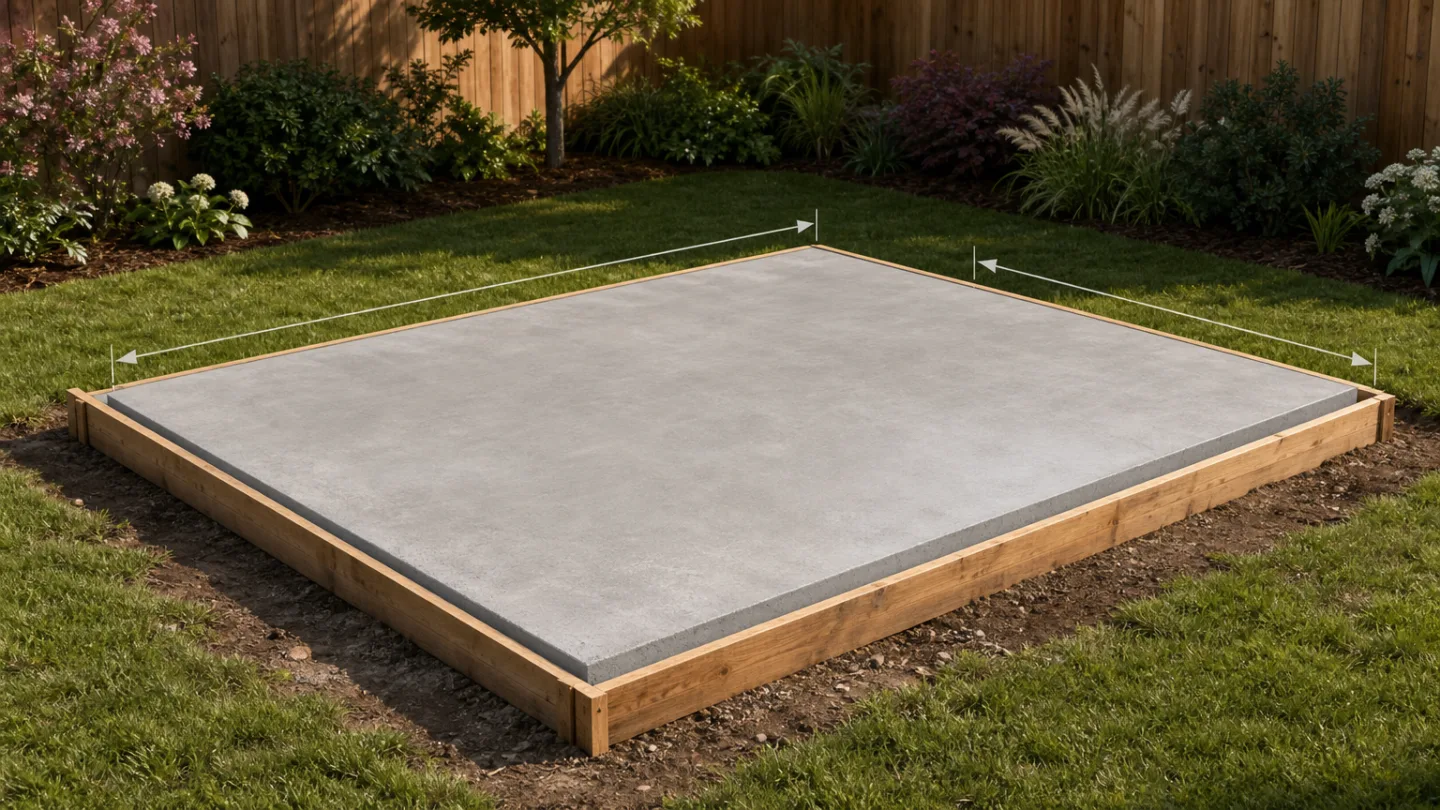
To work out how much concrete you need for a rectangular slab, multiply its length by its width by its thickness. The important detail is that all three measurements must use the same units. Then convert the result into the unit your supplier uses and add an allowance suited to the project.
This guide covers the calculation, not structural design. The example thicknesses are calculation inputs, not recommendations. Required thickness, reinforcement, and other design details depend on project type, loads, local codes, site conditions, and professional design.
The concrete slab formula
Concrete volume = length × width × thickness
If all dimensions are in feet, the result is cubic feet. If all dimensions are in meters, the result is cubic meters. For US ready-mix quantities, convert cubic feet to cubic yards by dividing by 27.
- US formula: cubic yards = length in feet × width in feet × (thickness in inches ÷ 12) ÷ 27.
- Metric formula: cubic meters = length in meters × width in meters × (thickness in millimeters ÷ 1,000).
You can check your measurements with Calcavera’s Concrete Slab Calculator. Whether you use a concrete calculator or work by hand, the result depends on accurate dimensions and the correct thickness unit.
Step 1: Measure the slab dimensions
- Measure the planned concrete length and width, using the inside dimensions of the forms where applicable.
- Use the thickness specified for your project.
- Check whether the slab includes separate sections, thickened edges, or other areas that need their own volume calculation.
- Record the units beside every measurement before calculating.
For a uniform rectangular slab, one length, one width, and one thickness are enough. If the base or thickness varies, a single nominal depth may not represent the actual volume accurately. Measure the variation and account for it rather than assuming that every part of the slab is identical.
Step 2: Convert the dimensions into consistent units
Slab length and width are often measured in feet while thickness is measured in inches. Metric projects commonly combine meters and millimeters. Convert the thickness before multiplying.
| Conversion | What to do |
|---|---|
| Inches to feet | Divide by 12 |
| Millimeters to meters | Divide by 1,000 |
| Feet to meters | Multiply by 0.3048 |
| Inches to meters | Multiply by 0.0254 |
| Cubic feet to cubic yards | Divide by 27 |
| Cubic yards to cubic feet | Multiply by 27 |
| Cubic feet to cubic meters | Multiply by 0.028316846592 |
| Cubic yards to cubic meters | Multiply by 0.764554857984 |
| Cubic meters to cubic yards | Multiply by approximately 1.30795 |
A cubic yard is a volume, not an area. It is a cube measuring 3 feet on each side: 3 × 3 × 3 = 27 cubic feet. A cubic meter is a cube measuring 1 meter on each side.
Keep the full calculation value until the final step. For example, use 4 ÷ 12 for a 4-inch thickness rather than rounding it early to 0.33 feet.
Step 3: Calculate the concrete volume
Example 1: 10 ft × 10 ft × 4 in
- Convert thickness: 4 ÷ 12 = one-third of a foot.
- Calculate volume: 10 × 10 × (4 ÷ 12) = 33.333… cubic feet.
- Convert to cubic yards: 33.333… ÷ 27 = 1.234567… cubic yards.
Result: approximately 1.23 cubic yards before any allowance.
Example 2: 20 ft × 20 ft × 4 in
- Convert thickness: 4 ÷ 12 = one-third of a foot.
- Calculate volume: 20 × 20 × (4 ÷ 12) = 133.333… cubic feet.
- Convert to cubic yards: 133.333… ÷ 27 = 4.938271… cubic yards.
Result: approximately 4.94 cubic yards before any allowance. Doubling both length and width makes this slab four times the area of the 10 ft × 10 ft example, so it needs four times the concrete at the same thickness.
Example 3: 5 m × 4 m × 100 mm
- Convert thickness: 100 ÷ 1,000 = 0.1 m.
- Calculate volume: 5 × 4 × 0.1 = 2 m³.
Result: 2 cubic meters before any allowance. No additional volume conversion is needed if your supplier quotes quantities in cubic meters.
How slab thickness changes the quantity
For a fixed footprint, concrete volume increases directly with thickness. Increasing thickness from 4 inches to 6 inches increases the volume by 50%; doubling thickness doubles the volume.
| Slab dimensions | Thickness | Theoretical volume |
|---|---|---|
| 10 ft × 10 ft | 4 in | 1.23 yd³ |
| 10 ft × 10 ft | 6 in | 1.85 yd³ |
| 5 m × 4 m | 100 mm | 2.00 m³ |
| 5 m × 4 m | 150 mm | 3.00 m³ |
These are quantity comparisons only. Do not choose slab thickness solely to match a concrete order or reduce material use; use the requirements established for your project.
Step 4: Add a project-specific allowance
The formula gives the theoretical volume of a perfectly measured shape. Real projects can require additional concrete because of uneven subgrade, deeper spots, form movement or variation, spillage, and uncertainty in measurements or ordering.
Adjusted quantity = theoretical volume × (1 + allowance percentage ÷ 100)
For illustration, a 2 m³ slab with a 5% allowance becomes 2 × 1.05 = 2.10 m³. With a 10% allowance, it becomes 2 × 1.10 = 2.20 m³. These percentages are examples, not mandatory rules.
- A well-measured slab with a consistent base has different uncertainty from a slab with noticeable depth variation.
- Known deeper sections should be calculated explicitly, not hidden inside a generic allowance.
- Ask the supplier about ordering increments, minimum quantities, and how the final order should be rounded.
Keep the theoretical volume, chosen allowance, and final order quantity separate in your notes. Rounded example figures in this guide are not supplier ordering instructions.
Step 5: Convert volume into ready-mix or bagged concrete
Ready-mix concrete
For ready-mix, the adjusted volume is the starting point for your order: typically cubic yards for US projects or cubic meters for metric projects. Confirm the supplier’s units and ordering increments before placing the order.
For example, the 20 ft × 20 ft × 4 in slab has a theoretical volume of approximately 4.9383 yd³. An illustrative 10% allowance gives 4.9383 × 1.10 = approximately 5.4321 yd³. Confirm how that quantity should be ordered rather than treating a displayed value such as 5.43 yd³ as an exact purchasing instruction.
Bagged concrete
Bagged concrete is calculated using the product’s finished-concrete yield per bag. Yields vary by product and manufacturer, so check the packaging or manufacturer specifications rather than relying on a fixed yield for all bags.
Number of bags = adjusted concrete volume ÷ stated yield per bag
Use matching volume units, then round up to a whole bag. As a hypothetical example, if a product states a yield of 0.60 ft³ per bag, the 10 ft × 10 ft × 4 in slab with an illustrative 10% allowance would require:
- Adjusted volume: 33.333… × 1.10 = 36.666… ft³.
- Bag calculation: 36.666… ÷ 0.60 = 61.111… bags.
- Round up: 62 bags.
The 0.60 ft³ figure is only an example input; replace it with the yield of the product you intend to buy. When choosing between bags and ready-mix, consider the total bag count, handling and mixing effort, access, and the planned placement sequence. Volume alone does not settle that decision.
How to calculate concrete for irregular slabs
For an L-shaped or stepped slab, divide the footprint into simple, non-overlapping rectangles. Calculate each rectangle separately and add the results.
For example, an L-shaped slab might consist of a 4 m × 3 m rectangle and an adjoining 2 m × 2 m rectangle, both 0.1 m thick:
- Section A: 4 × 3 × 0.1 = 1.2 m³.
- Section B: 2 × 2 × 0.1 = 0.4 m³.
- Total: 1.2 + 0.4 = 1.6 m³ before any allowance.
Do not count the same area twice. If sections have different thicknesses, calculate each with its own thickness. For curved boundaries or other shapes, determine each section’s area using the appropriate geometry, then multiply by its thickness. A concrete volume calculator is only as accurate as the shape and measurements entered.
Common concrete calculation mistakes
- Forgetting the thickness conversion: entering 4 feet instead of 4 inches makes the thickness, and therefore the volume, 12 times too large.
- Mixing units: feet, inches, meters, and millimeters cannot be multiplied together as though they were the same unit.
- Using area instead of volume: square feet or square meters describe the footprint, not the quantity of concrete.
- Ignoring irregular sections: one bounding rectangle can overestimate an L shape, while omitted extensions or thickened areas can underestimate it.
- Rounding too early: retain calculation precision until converting the final quantity.
- Ordering exactly the theoretical amount: assess real-world variation and agree an appropriate allowance rather than assuming the site matches the ideal shape perfectly.
- Assuming a universal bag yield: use the yield for the specific product, not bag weight alone.
Final checklist before ordering
- Confirm the slab dimensions and specified thickness.
- Convert all dimensions into consistent units.
- Calculate every section and add the volumes.
- Convert to cubic yards, cubic meters, or the unit used for bag yield.
- Add an allowance appropriate to the project.
- Confirm supplier increments or round the bag count up to whole bags.
References
For product-specific bag estimates, see the QUIKRETE Concrete Calculator and verify the selected product’s stated yield. For manufacturer guidance on mixing and placement, consult QUIKRETE’s Mixing & Placing Concrete training material.
Frequently asked questions
How much concrete do I need for a 10 ft × 10 ft slab that is 4 inches thick?
The theoretical volume is 10 × 10 × (4 ÷ 12) = 33.33 cubic feet. Divide by 27 to get approximately 1.23 cubic yards. Add an allowance appropriate to your site conditions and confirm ordering increments with your supplier.
How many cubic yards of concrete do I need for a 20 ft × 20 ft slab?
You also need the slab thickness. At 4 inches thick, the calculation is 20 × 20 × (4 ÷ 12) ÷ 27 = approximately 4.94 cubic yards before any allowance. A different thickness changes the required volume.
How do I calculate concrete in cubic meters?
Convert every dimension to meters, then multiply length × width × thickness. For example, a 5 m × 4 m slab with a thickness of 100 mm uses 5 × 4 × 0.1 = 2 cubic meters before any allowance.
What waste percentage should I add when ordering concrete?
There is no universal percentage for every project. Consider uneven subgrade, form variation, spillage, measurement uncertainty, and supplier ordering practices. A 5% or 10% allowance can be used to compare quantities, but choose the actual allowance based on your project and supplier advice.
How many bags of concrete do I need?
Divide the required concrete volume, including your chosen allowance, by the finished-concrete yield stated on the bag or in the manufacturer's specifications. Use matching volume units and round up to a whole number of bags. Bag weight alone is not enough to determine yield.
Can I calculate an L-shaped slab with the same formula?
Yes. Divide the L shape into non-overlapping rectangles, calculate length × width × thickness for each rectangle, and add the volumes. If the sections have different thicknesses, use the correct thickness for each one.