
On this page
- The basic paint quantity formula
- How to measure a room’s paintable wall area
- Worked example: a 12-by-15-foot room
- Worked example: one accent wall
- Paint coverage per gallon: what the number means
- One coat versus two coats
- Quick comparison: one coat versus two coats
- Estimate ceiling paint separately
- Primer is a separate estimate
- US gallons, quarts and liters
- Turn the estimate into a purchase plan
- Common paint-estimating mistakes
- Measurement and shopping checklist
What you need to know
To estimate how much paint you need, multiply the net paintable surface area by the number of coats, then divide by the selected paint’s verified coverage per US gallon. The result is a theoretical quantity. Surface texture, porosity, application method and paint left in equipment can increase actual consumption, so check those conditions before choosing containers.
For example, 395 square feet of walls receiving two coats at 350 square feet per gallon need about 2.26 US gallons theoretically. If you are buying only one-gallon containers, that means purchasing 3 gallons—not counting separate ceiling paint, trim paint or primer.
Use Calcavera’s Paint Calculator to estimate paint from room dimensions, openings, coats and coverage. It supports door and window deductions, unit conversion and market-dependent cost estimates. Use the measurements and product information below to make those inputs reliable; calculate ceiling and trim requirements separately.
The basic paint quantity formula
Paint required (US gallons) = [Net paintable area (sq ft) × Number of coats] ÷ Verified coverage (sq ft per US gallon per coat)
In plain English: measure the surface that will receive the paint, count how many times it will be coated, and divide that total coating area by the area one gallon is expected to cover.
- Net paintable area: the actual surface area receiving that product and color, after appropriate deductions.
- Number of coats: the planned finish coats required for the selected product and surface.
- Verified coverage: the coverage stated for the chosen product, checked against its label, technical data sheet and application conditions.
This formula provides a starting quantity, not a guarantee of consumption. Application losses or a separately chosen project contingency may increase the purchase quantity. Avoid counting the same allowance twice if your working coverage rate already accounts for difficult conditions.
How to measure a room’s paintable wall area
1. Calculate gross wall area
For a rectangular room with walls of equal height:
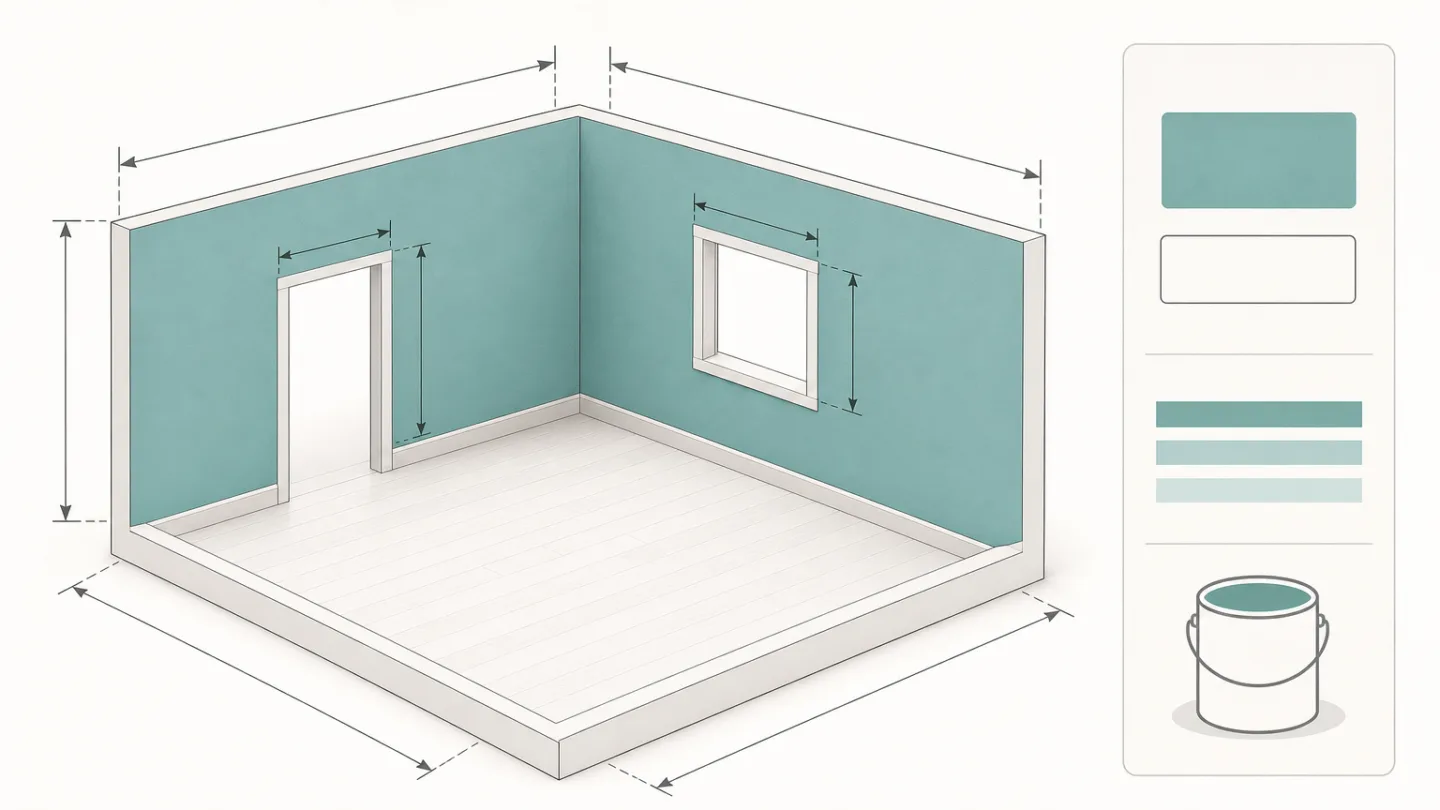
Gross wall area = 2 × (Room length + Room width) × Wall height
The first part, 2 × (length + width), gives the room’s perimeter. Multiplying that perimeter by wall height gives the combined area of the four walls.
Measure consistently in feet to obtain square feet. Convert inches to feet before calculating: 6 inches is 0.5 foot. For reference, 1 foot equals 0.3048 meter, and 1 square foot is approximately 0.0929 square meter.
For irregular rooms or varying wall heights, measure each wall section separately and add the areas. Break unusual shapes into rectangles and triangles rather than forcing them into a rectangular-room formula.
2. Subtract doors and windows that will not receive wall paint
Net wall area = Gross wall area − Unpainted opening area
Measure each opening’s width and height, multiply them to find its area, then subtract the total. Make these deductions when the openings will not receive the same wall paint.
If painted window returns, recesses or other surfaces are not represented by the basic wall measurement, measure and add them separately. An opening deduction does not estimate paint for a door slab, frame or window trim.
3. Separate products, colors and surfaces
Doors, frames, baseboards, crown molding, cabinets and other surfaces painted with a different product, color or finish need separate estimates. Do not assume surplus wall paint can substitute for the specified trim or cabinet coating.
Worked example: a 12-by-15-foot room
This example covers the walls only. Ceiling, trim and primer are excluded.
- Room length: 12 feet.
- Room width: 15 feet.
- Wall height: 8 feet.
- One unpainted door opening: 3 × 7 feet.
- One unpainted window opening: 4 × 4 feet.
- Finish coats: two.
- Assumed verified coverage: 350 square feet per US gallon per coat.
- Perimeter: 2 × (12 + 15) = 54 feet.
- Gross wall area: 54 × 8 = 432 square feet.
- Door opening: 3 × 7 = 21 square feet.
- Window opening: 4 × 4 = 16 square feet.
- Net paintable wall area: 432 − 21 − 16 = 395 square feet.
- Area to coat twice: 395 × 2 = 790 square feet.
- Theoretical paint quantity: 790 ÷ 350 = approximately 2.26 US gallons.
If purchasing whole one-gallon containers, round up to 3 gallons. That purchase contains approximately 11.36 liters; the theoretical requirement is approximately 8.54 liters.
Other available container sizes may support a different purchase plan. Before deciding, consider likely application losses, any project-specific contingency and whether you want to retain paint for future touch-ups. The gap between 2.26 and 3 gallons is already a purchasing margin; an additional allowance is not automatically necessary.
Worked example: one accent wall
Suppose an accent wall is 12 feet wide and 8 feet high, with no openings. You plan two coats, and the selected paint’s verified coverage is 350 square feet per US gallon per coat.
- Wall area: 12 × 8 = 96 square feet.
- Two-coat area: 96 × 2 = 192 square feet.
- Theoretical paint: 192 ÷ 350 = approximately 0.55 US gallon, or 2.08 liters.
Two US quarts equal only 0.5 gallon, which is below this theoretical requirement. Compare available quart and gallon options, allowing for actual conditions. Keep this accent color separate from the estimate for the other walls.
Paint coverage per gallon: what the number means
A commonly referenced coverage range is 350–400 square feet per US gallon for one coat. Treat that range as an illustration, not a universal specification. Some products have lower stated coverage, and different formulations can have substantially different requirements.
The selected product’s label and technical data sheet take priority. Check the specified substrate, application method, spread rate and coating thickness. Do not stretch paint beyond the recommended application rate simply to make an estimated quantity last.
If the manufacturer gives a coverage range, select a planning value appropriate to the documented conditions. If the surface or method is unusual, seek product-specific guidance rather than automatically using the highest coverage number.
What changes actual coverage?
- Porosity and texture: absorbent surfaces can take up more coating, while rough profiles increase the actual surface area being coated.
- Bare drywall versus painted walls: unsealed drywall and joint compound may absorb unevenly. A sound, previously painted surface presents different preparation and coating needs.
- Application method: brushing, rolling and spraying can produce different transfer losses and consumption. Spray setup and technique matter.
- Color changes: a strong color change may require additional coats or a specified primer to achieve the intended appearance. It does not automatically change the labeled spread rate.
- Surface condition and preparation: repairs, chalking, contamination or uneven sealing can affect the result. Correct preparation comes before quantity planning.
- Product formulation: different coatings have different spread rates, application thicknesses and substrate requirements.
- Paint retained in equipment: some material remains in rollers, brushes, trays, hoses and other equipment rather than reaching the surface.
One coat versus two coats
At the same assumed coverage rate, two coats require twice the theoretical paint quantity of one coat. Actual consumption can differ between coats, especially when the first application changes how absorbent the surface is.
Do not assume every surface needs two coats—or that any particular product will cover every surface in one. Follow the selected coating system’s instructions and consider the existing color, new color, substrate and desired appearance.
If you are unsure whether an additional coat will be needed, test a representative area and confirm the manufacturer’s requirements before finalizing the purchase. Do not apply a single excessively heavy coat as a substitute for the prescribed coating system.
Quick comparison: one coat versus two coats
Assumptions: the areas below are net paintable surface areas, not floor areas. Every calculation uses an illustrative coverage of 350 square feet per US gallon per coat. Quantities are theoretical, rounded to two decimal places, and exclude primer, losses, contingency and container rounding.
| Net paintable area | One coat: US gallons | Two coats: US gallons |
|---|---|---|
| 400 sq ft | 1.14 | 2.29 |
| 600 sq ft | 1.71 | 3.43 |
| 800 sq ft | 2.29 | 4.57 |
| 1,000 sq ft | 2.86 | 5.71 |
| 1,500 sq ft | 4.29 | 8.57 |
Use unrounded calculations when totaling a project. Round for purchasing only after grouping compatible paint requirements and reviewing available container sizes.
Estimate ceiling paint separately
For a flat rectangular ceiling:
Ceiling area = Room length × Room width
The example room’s ceiling is 12 × 15 = 180 square feet. If it receives two coats of ceiling paint rated at 350 square feet per US gallon per coat, its theoretical requirement is 180 × 2 ÷ 350 = approximately 1.03 gallons.
Use the actual ceiling product’s coverage and coat count. A sloped, vaulted or irregular ceiling requires its actual surface area, not an assumption that it equals the floor area. Measure each plane and add the areas.
Keep this as a separate manual calculation rather than assuming the wall calculator independently includes ceiling paint. Estimate trim separately as well, using the surfaces that will actually be painted—not linear footage alone.
Primer is a separate estimate
Primer and finish paint are different materials with potentially different coverage rates and coat requirements. Estimate each independently:
Primer required = [Area needing primer × Primer coats] ÷ Primer coverage per gallon
Use the primer manufacturer’s stated coverage and the substrate’s requirements. A full priming coat and spot priming over repairs involve different areas.
A product described as paint and primer in one does not remove the need for surface-specific preparation or a separate primer in every situation. Check the coating system’s guidance for bare substrates, stains, adhesion concerns and other special conditions.
US gallons, quarts and liters
- 1 US gallon ≈ 3.785 liters.
- 1 US quart = 0.25 US gallon ≈ 0.946 liter.
- 4 US quarts = 1 US gallon.
- 1 imperial gallon ≈ 4.546 liters. It is not the same as a US gallon.
To convert US gallons to liters, multiply by approximately 3.785. To convert liters to US gallons, divide by approximately 3.785. Keep the coverage units consistent: square feet per US gallon cannot be used directly as square meters per liter.
Turn the estimate into a purchase plan
Round up to available containers
First calculate the theoretical requirement. Then account for expected application losses or a separately chosen contingency where warranted. Finally, select available containers that meet or exceed that planned quantity.
There is no single best package combination for every job. A gallon-plus-quart combination may suit one project, while another needs several gallons or a larger container. Availability, product, color, handling, leftover storage and current local pricing all affect the choice.
Avoid rounding down just because the calculated amount is close to a container size. Equally, do not add multiple overlapping allowances without checking how much extra paint you are already buying.
Group multiple rooms by compatible paint
Measure every room separately, then create one estimate line for each product, color and finish. Within a compatible group, account for each room’s coat count before adding requirements.
Group quantity = Sum of each surface’s [Net area × Its coat count ÷ Its applicable coverage]
If coverage is identical throughout the group, you can add the coat-adjusted areas first and divide once. Keep different colors, finishes, products and primers separate, even when their combined quantity would fit conveniently into a larger container.
For contractor or renovation estimates, record the assumptions alongside each line item: measured area, deductions, substrate, preparation, coats, coverage, loss allowance and purchased quantity. Use current supplier quotes for costs; calculator cost outputs remain market-dependent estimates.
Common paint-estimating mistakes
- Using floor area as wall area: wall paint depends on perimeter and height.
- Forgetting wall height: rooms with the same footprint can have very different wall areas.
- Leaving out coats: a one-coat quantity does not automatically cover a two-coat specification.
- Assuming universal coverage: use the exact product’s documentation, not a generic number alone.
- Forgetting doors and windows: deduct openings that will not receive wall paint, and estimate their painted components separately.
- Combining primer and finish paint: each has its own coverage and required quantity.
- Ignoring texture or porosity: smooth, sealed walls are not equivalent to rough or absorbent substrates.
- Overlooking ceilings and trim: include them as separate scope items when they are part of the project.
- Rounding every intermediate result: retain precision until the final purchase calculation.
Measurement and shopping checklist
- Measure room length, width and wall height; record irregular wall sections separately.
- Measure door and window openings and identify which areas will not receive the wall paint.
- List ceilings, trim, doors, cabinets and other separately painted surfaces.
- Choose the product, color and finish for each surface group.
- Check substrate condition and determine preparation and primer requirements.
- Confirm coverage and coat counts from each product’s label and technical data sheet.
- Calculate net area, multiply by coats and divide by the applicable coverage.
- Review texture, application method, equipment retention and any project-specific contingency.
- Combine only compatible paint requirements, then round up to available container sizes.
- Record product names, colors, finishes and quantities for purchasing and future touch-ups.
The most useful paint estimate is a documented one: measured surface area, a clear coat plan, product-specific coverage and a purchase quantity matched to actual conditions.
Frequently asked questions
How many gallons of paint do I need for a 12-by-15-foot room?
With 8-foot walls, one 3-by-7-foot door opening and one 4-by-4-foot window opening, the net wall area is 395 square feet. Two coats at a verified coverage rate of 350 square feet per US gallon require about 2.26 gallons theoretically. If buying only one-gallon containers, round up to 3 gallons. Ceiling, trim and primer are separate.
How much does one gallon of paint cover?
A commonly referenced illustration is 350–400 square feet per US gallon for one coat, but this is not a universal specification. Some products state lower coverage. Use the selected paint’s label and technical data sheet, accounting for the surface and application conditions.
Does two coats mean twice as much paint?
For an estimate using the same coverage rate for each coat, yes: multiply the net paintable area by two. Actual consumption can differ between coats, particularly on porous surfaces. Follow the product’s preparation and coat requirements rather than assuming every job needs the same system.
Can I calculate wall paint from a room’s floor area?
Not reliably. Wall area depends on the room’s perimeter and wall height, not just its floor area. For a rectangular room, use 2 × (length + width) × wall height, then subtract openings that will not receive the wall paint.
Should primer be included in my paint quantity?
Estimate primer separately using its own coverage rate and required coat count. Substrate condition and the selected coating system determine whether primer is needed. A paint-and-primer-in-one label does not eliminate every need for a separate primer.
How many liters are in a gallon of paint?
One US gallon is approximately 3.785 liters, and one US quart is 0.25 US gallon, or approximately 0.946 liter. An imperial gallon is approximately 4.546 liters, so check which gallon unit a product or calculator uses.