
On this page
- What does solar panel wattage mean?
- Panel wattage versus total system capacity
- 400W vs 450W vs 500W solar panels: comparison table
- Worked examples: panel counts for 5kW and 10kW
- Higher wattage does not automatically mean higher efficiency
- How panel wattage affects roof-space requirements
- Roof geometry and shading can change the answer
- Panel wattage, string design and inverter compatibility
- When each wattage range may be useful
- How wattage affects installation cost
- Homeowner checklist: compare the exact module specifications
- Estimate your system before choosing a panel
- Technical references and scope
- The bottom line
What you need to know
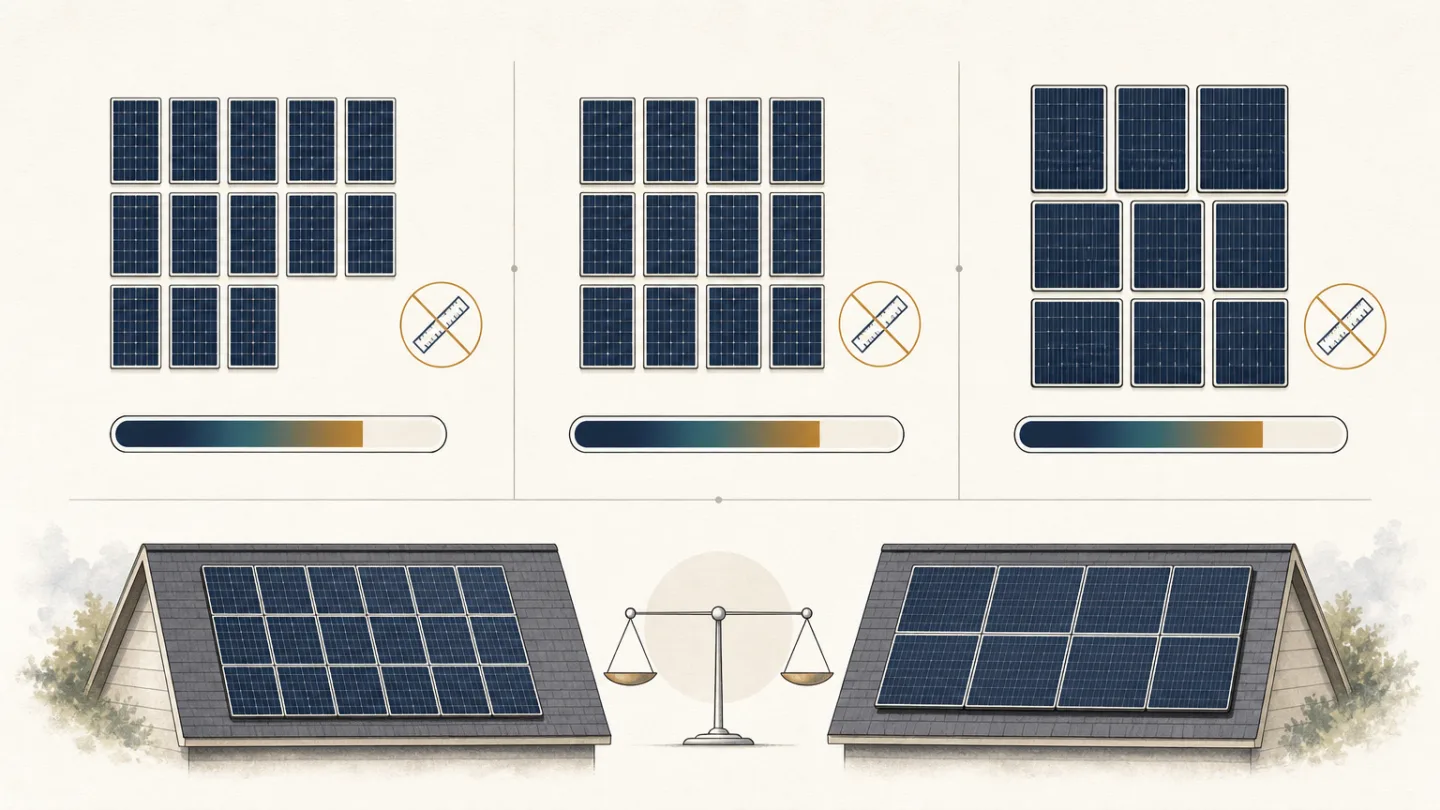
Choosing between 400W, 450W and 500W solar panels is not simply a matter of picking the biggest number. A higher-wattage panel provides more rated power per module, but it may also be larger, have different electrical characteristics or fit your roof less effectively.
Compare total array capacity, usable roof space, expected annual generation, inverter compatibility and installed cost to find the best option for your home.
This guide is intended for U.S. homeowners. Roof-area examples include both square meters and approximate square-foot equivalents. Electrical, mounting and roof-setback requirements vary by location; your installer must check the requirements that apply to your project.
What does solar panel wattage mean?
A panel's wattage is its rated maximum DC power output under standard test conditions, commonly abbreviated STC. These conditions use irradiance of 1,000 watts per square meter, a cell temperature of 25°C (77°F) and a standardized solar spectrum.
A 400W module is therefore rated to produce 400 watts under those test conditions. It does not continuously produce 400 watts throughout daylight hours. Actual output changes with sunlight, cell temperature, shading, orientation and other operating conditions.
Watts describe power at a particular moment. Kilowatt-hours describe energy produced over time. Panel wattage alone cannot tell you how much electricity your home will receive in a day or year.
Five specifications that should not be confused
- Wattage: the module's rated DC power output.
- Efficiency: the share of incoming solar power converted into electrical power under specified conditions.
- Physical size: the module's length, width and thickness, which affect placement and installation.
- Voltage and current: electrical characteristics that determine compatibility with strings, inverter inputs and other equipment.
- Total array capacity: the combined rated DC output of all installed modules.
Two panels with different wattage ratings may also differ in cell technology, dimensions, voltage, current, weight and intended application. A wattage label does not establish that they are interchangeable.
Panel wattage versus total system capacity
Array capacity in watts = number of panels × rated watts per panel.
For example, 25 panels rated at 400W and 20 panels rated at 500W both provide a 10,000W, or 10kW, DC array. The second system has fewer panels, not more total rated capacity.
If the systems have comparable orientation, shading, operating characteristics and losses, their annual output may be similar. Different layouts, temperatures, inverter sizing and module performance can still change the result.
Always check whether a proposal's system size refers to DC panel capacity or AC inverter capacity. These are different ratings and need not be equal.
400W vs 450W vs 500W solar panels: comparison table
The table compares rated capacity and panel counts. Physical dimensions and efficiency must come from the specific manufacturer's datasheet.
| Comparison point | 400W panels | 450W panels | 500W panels |
|---|---|---|---|
| Rated power per module | 0.40kW DC | 0.45kW DC | 0.50kW DC |
| Panels to meet or exceed 5kW | 13 | 12 | 10 |
| Resulting DC capacity | 5.20kW | 5.40kW | 5.00kW |
| Panels to meet or exceed 10kW | 25 | 23 | 20 |
| Resulting DC capacity | 10.00kW | 10.35kW | 10.00kW |
| Physical dimensions | Check the selected model | Check the selected model | Check the selected model |
| Efficiency | Model-specific | Model-specific | Model-specific |
| Potential design advantage | More placement flexibility if the selected module is smaller | Higher power per module than 400W, with fit depending on dimensions | Fewer modules for the same target capacity |
| Potential design limitation | More modules and connections for a given capacity | Whole-panel rounding may move the array above or below its target | A physically larger model may fit irregular roof areas poorly |
These are capacity calculations, not approved installation designs. An inverter's string requirements or the available roof layout may call for a different panel count.
Worked examples: panel counts for 5kW and 10kW
Required panel count = target DC system size in watts ÷ panel wattage.
You cannot install a fraction of a panel. Round up if the goal is to meet or exceed a capacity target; consider the lower whole-panel option if the target is approximate. The final decision must also satisfy electrical and roof-layout constraints.
A nominal 5kW system
- 400W: 5,000 ÷ 400 = 12.5 panels. Twelve panels provide 4.8kW; 13 provide 5.2kW.
- 450W: 5,000 ÷ 450 ≈ 11.11 panels. Eleven panels provide 4.95kW; 12 provide 5.4kW.
- 500W: 5,000 ÷ 500 = 10 panels, providing exactly 5kW.
A 4.95kW array may be a sensible match for an approximate 5kW goal. It should nevertheless be described using its actual DC capacity rather than treated as exactly 5kW.
A nominal 10kW system
- 400W: 10,000 ÷ 400 = 25 panels, providing exactly 10kW.
- 450W: 10,000 ÷ 450 ≈ 22.22 panels. Twenty-two panels provide 9.9kW; 23 provide 10.35kW.
- 500W: 10,000 ÷ 500 = 20 panels, providing exactly 10kW.
When comparing quotes, account for these differences. A 10.35kW proposal is not a like-for-like capacity comparison with a 10kW proposal, even if both are marketed as approximately 10kW.
Higher wattage does not automatically mean higher efficiency
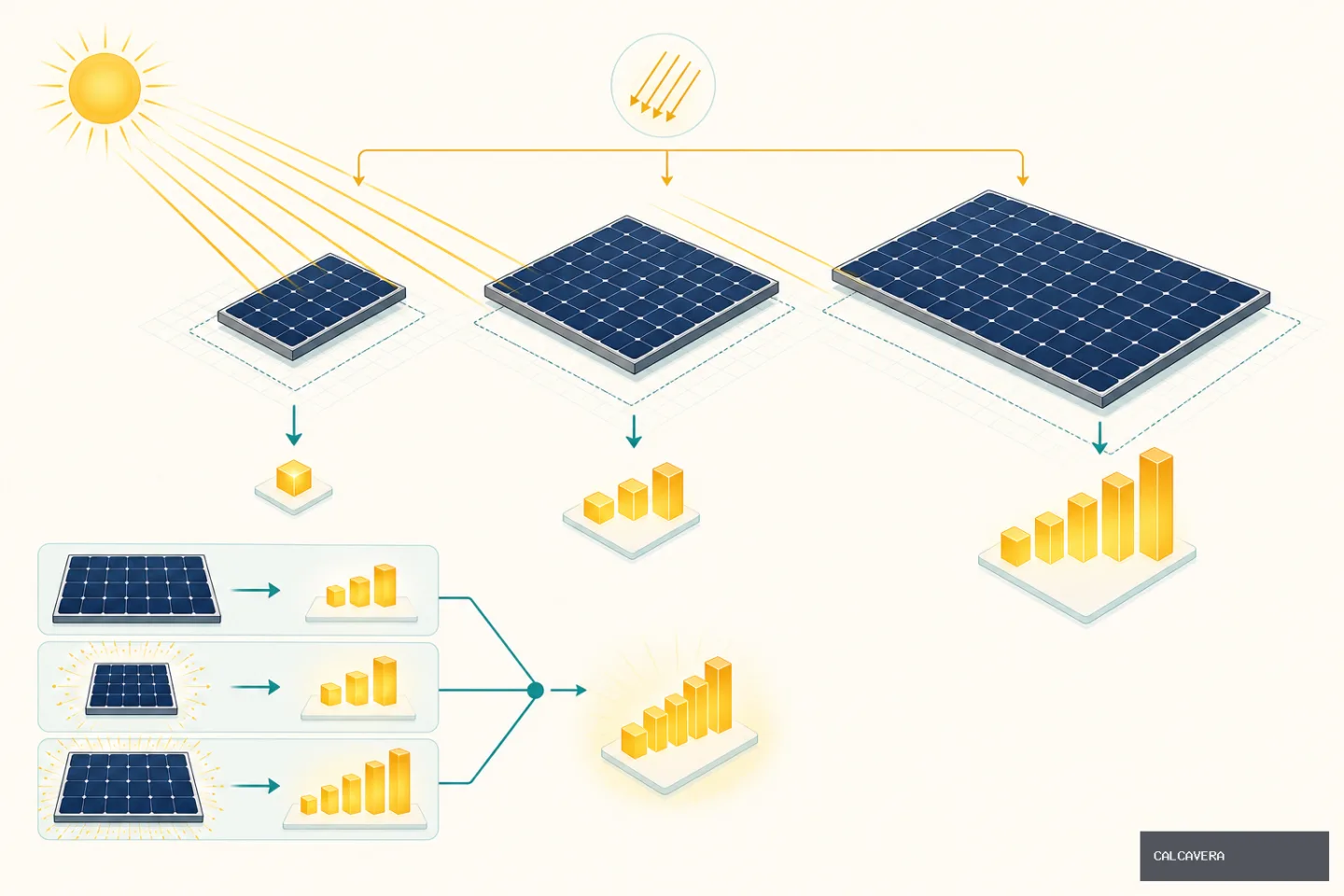
A panel can achieve a higher wattage by converting sunlight more efficiently, by collecting sunlight over a larger area, or through a combination of both.
At standard test irradiance, the relationship is approximately:
Rated power = module area × 1,000W/m² × module efficiency.
Use efficiency as a decimal and area in square meters in this calculation. At an illustrative 20% efficiency, a 400W module corresponds to 2.00m² (21.5 sq ft) of module area, a 450W module to 2.25m² (24.2 sq ft) and a 500W module to 2.50m² (26.9 sq ft).
These are calculated teaching examples, not dimensions or specifications of actual products. Square-foot equivalents are rounded.
Check both the efficiency percentage and the actual length and width to see whether the extra power comes from better efficiency, greater size or both.
How panel wattage affects roof-space requirements
Start with the dimensions of the exact proposed module:
Module-face area = panel count × module length × module width.
Use feet for both dimensions to calculate square feet, or meters for both to calculate square meters. This gives the combined area of the panels themselves, not the full roof area needed for installation. Gaps, roof edges, access routes, mounting constraints and applicable setbacks can increase the required footprint.
Illustrative area comparison at equal efficiency
The following example uses the calculated areas above and assumes all three options have the same 20% efficiency. It is not a manufacturer comparison or a roof-fit estimate. Square-foot equivalents are approximate.
| Panel rating | Illustrative area per panel | At least 5kW: count and module-face area | At least 10kW: count and module-face area |
|---|---|---|---|
| 400W | 2.00m² (21.5 sq ft) | 13 panels: 26.00m² (279.9 sq ft) | 25 panels: 50.00m² (538.2 sq ft) |
| 450W | 2.25m² (24.2 sq ft) | 12 panels: 27.00m² (290.6 sq ft) | 23 panels: 51.75m² (557.0 sq ft) |
| 500W | 2.50m² (26.9 sq ft) | 10 panels: 25.00m² (269.1 sq ft) | 20 panels: 50.00m² (538.2 sq ft) |
At equal efficiency, equal total capacity needs approximately equal module area. The small differences here arise from rounding panel counts and therefore installing different capacities.
Roof geometry and shading can change the answer
A large, uninterrupted roof plane may accommodate fewer higher-wattage modules neatly. A roof with dormers, vents, skylights, hips or narrow sections may benefit from physically smaller modules, if those modules fit more effectively around the obstacles.
For example, a narrow usable section might accept an additional smaller module but no additional larger one. In that case, the smaller-module layout could deliver more total capacity despite having a lower wattage per panel.
Shading also matters. The location of a shadow, the module's internal electrical arrangement, bypass diodes and the inverter architecture all influence its effect. Do not assume that fewer panels automatically means fewer shading losses.
- Compare scaled layouts using actual module dimensions.
- Identify which proposed modules are shaded and at what times.
- Check portrait and landscape options against the mounting instructions.
- Compare expected annual production, not just maximum panel count.
Module-level electronics can help manage some mismatch conditions, but they cannot recover sunlight that never reaches the cells.
Panel wattage, string design and inverter compatibility
Wattage is only one part of an electrical design. For each candidate module, the installer needs its open-circuit voltage, maximum-power voltage, short-circuit current, maximum-power current and relevant temperature coefficients.
String inverters
In a series string, module voltages add while the string carries a common current. Fewer higher-wattage panels may therefore produce a different string voltage—not necessarily a higher one.
The designer must verify that cold-weather open-circuit voltage stays within equipment limits and that operating voltage remains suitable across the expected temperature range. Input current limits, parallel strings and protection requirements must also be checked.
A short string of high-wattage panels can be unsuitable if its operating voltage is too low for the inverter's tracking range. Conversely, a longer string can exceed voltage limits. Neither issue can be resolved by looking at total watts alone.
Microinverters and optimizers
Check the exact manufacturer's compatibility requirements. A module's wattage may appear appropriate while its voltage or current falls outside the permitted range.
For microinverters, compare each unit's AC output capability with the connected module's expected production. For optimizers, check both module compatibility and the system's string requirements.
DC-to-AC sizing
DC-to-AC ratio = total array DC rating ÷ inverter AC rating.
For example, a 10kW DC array connected to an 8kW AC inverter has a ratio of 1.25. This is an arithmetic illustration, not a recommendation for every home.
Designers may use an array larger than the inverter's AC rating because panels do not operate at their STC rating all day. However, high-output periods can cause clipping, when available DC power exceeds the inverter's AC output capability.
The appropriate balance depends on climate, orientation, shading, expected energy losses and the inverter's permitted connected power, voltage and current. Increasing module wattage without rechecking the inverter can create a poor or incompatible design.
When each wattage range may be useful
400W panels
A 400W solar panel for home use can be attractive when the selected model's dimensions suit smaller roof sections or a complicated layout. For a given target capacity, expect more modules than with 450W or 500W alternatives.
450W panels
A 450W option may provide a useful balance between power per module and roof fit, depending on its dimensions and electrical specifications.
500W panels
A 500W solar panel for home use may suit an open roof with room for the selected module format. Fewer modules can mean fewer individual placement operations and connections, but larger or heavier modules can complicate handling and mounting.
Residential installers may prefer a particular range because it works with their mounting systems, familiar inverter designs, installation methods, supplier availability and local service arrangements. Ask how that preference benefits your specific roof.
How wattage affects installation cost
Fewer panels can reduce some module-related installation work, but that does not guarantee a lower total price. Module prices, handling requirements, mounting hardware, roof complexity and electrical equipment all contribute to cost.
Compare quotes using:
- Total installed price for a clearly defined scope.
- Price per installed DC watt to account for differences in capacity.
- Estimated annual generation using comparable assumptions.
- Included equipment and services, such as inverter configuration, monitoring and workmanship coverage.
Do not compare only the price per panel. A 500W module and a 400W module supply different amounts of rated capacity, and their installation requirements may differ.
Homeowner checklist: compare the exact module specifications
- Confirm the model and datasheet revision. Product families can contain several power classes and dimensions.
- Check dimensions and weight. Request a scaled roof layout and confirmation of mounting suitability.
- Compare efficiency. Look beyond watts per panel to power per unit area.
- Check voltage and current. Ask the installer to confirm compatibility with the proposed inverter and string arrangement.
- Compare the power temperature coefficient. A less negative coefficient indicates a smaller rated power reduction per degree of cell-temperature increase, all else equal. Do not confuse it with voltage or current coefficients.
- Read the degradation warranty. Compare any initial-year allowance, subsequent annual allowance and guaranteed remaining output at the same age. These are warranty commitments, not predictions of exact real-world performance.
- Separate product and performance warranties. Check exclusions, claim procedures and whether labor or other claim-related costs are covered.
- Review shading and production assumptions. Ask how the estimate accounts for orientation, temperature, inverter losses and clipping.
- Compare the entire installation. Include equipment, workmanship terms, roof fit and installed price.
Use current manufacturer technical datasheets and warranty documents for the exact models being quoted. This guide does not assign real-product dimensions, efficiency values or warranty terms to a wattage category.
Estimate your system before choosing a panel
Use the Calcavera Solar Panel Calculator to explore system size, panel count and roof-space requirements with your own project assumptions. Test 400W, 450W and 500W options, and use actual module dimensions wherever the calculation requires panel area.
Treat the result as a planning estimate. A final design needs a roof assessment, shading review and equipment compatibility checks.
Technical references and scope
The U.S. Department of Energy's Solar Photovoltaic Cell Basics explains photovoltaic conversion, efficiency and temperature effects.
NREL's PVWatts Calculator provides a framework for estimating PV energy production using system capacity, location, orientation and loss assumptions.
Panel-count examples are direct arithmetic. Roof-area examples are explicitly hypothetical and are not quoted manufacturer specifications. For purchasing and electrical design, use the current documents for the exact module, inverter and mounting system.
The bottom line
Before accepting a quote, ask for a scaled layout, an equipment compatibility check and an annual production estimate so you can compare the proposed systems on practical terms.
Frequently asked questions
Are 500W solar panels better than 400W panels?
Not automatically. Compare the exact models' efficiency, dimensions, electrical compatibility and warranty terms, then assess the complete installed designs. A well-fitting 400W array may be more practical for your roof.
How many 400W solar panels do I need?
Divide your target DC system capacity in watts by 400. A nominal 5kW target gives 12.5 panels, so practical options include 12 panels at 4.8kW or 13 panels at 5.2kW. A 10kW array requires 25 panels. Your electricity use, expected local production and usable roof area determine the appropriate system capacity.
How many 500W solar panels do I need?
Ten 500W panels provide 5kW of rated DC capacity, while 20 provide 10kW. These figures describe array capacity, not guaranteed electricity production. The final design must also accommodate roof layout, shading and inverter requirements.
Does a higher-wattage panel use less roof space?
Not necessarily. At equal efficiency, equal total capacity requires approximately equal module area. Actual roof-space requirements also depend on panel dimensions, layout, gaps and setbacks.
Can I use 500W solar panels on a residential roof?
Potentially, yes. Check the actual module dimensions, weight, mounting requirements, handling access and inverter compatibility. Some larger modules may be awkward on roofs with dormers, obstructions or narrow usable sections.
Can I mix 400W, 450W and 500W panels in one system?
Sometimes, but this requires an electrical design check. Modules connected in the same series string share current, and differences in their electrical characteristics can cause mismatch losses. Separate inverter inputs or compatible module-level electronics may offer options, but suitability depends on the specific equipment rather than wattage labels alone.
Does a 5kW solar array need a 5kW inverter?
Not necessarily. The panel total is a DC rating, while the inverter has an AC output rating. Designers may choose a DC array larger than the inverter's AC rating, provided voltage, current, connected-power and other equipment limits are satisfied. The appropriate ratio depends on climate, orientation, expected clipping and the manufacturer's requirements.
Which solar panel wattage is best for a home?
Choose the module that best meets your system-capacity goal within your roof, budget and equipment constraints. Ask installers to compare scaled layouts and expected annual generation.