
On this page
- The basic concrete volume formula
- Metric concrete calculations and conversions
- Worked concrete quantity examples
- Concrete quantity table for example slabs
- Applying the method to common projects
- From theoretical volume to a practical order quantity
- How many bags of concrete do I need?
- Ready-mix or bagged concrete?
- Reinforcement, soil and design: what volume calculations do not decide
- Common concrete calculation mistakes
- A practical concrete quantity checklist
- Technical references and product information
What you need to know
To work out how much concrete you need, calculate the volume of the space you intend to fill. For a rectangular slab or footing, multiply length by width by thickness or depth, with every measurement expressed in compatible units.
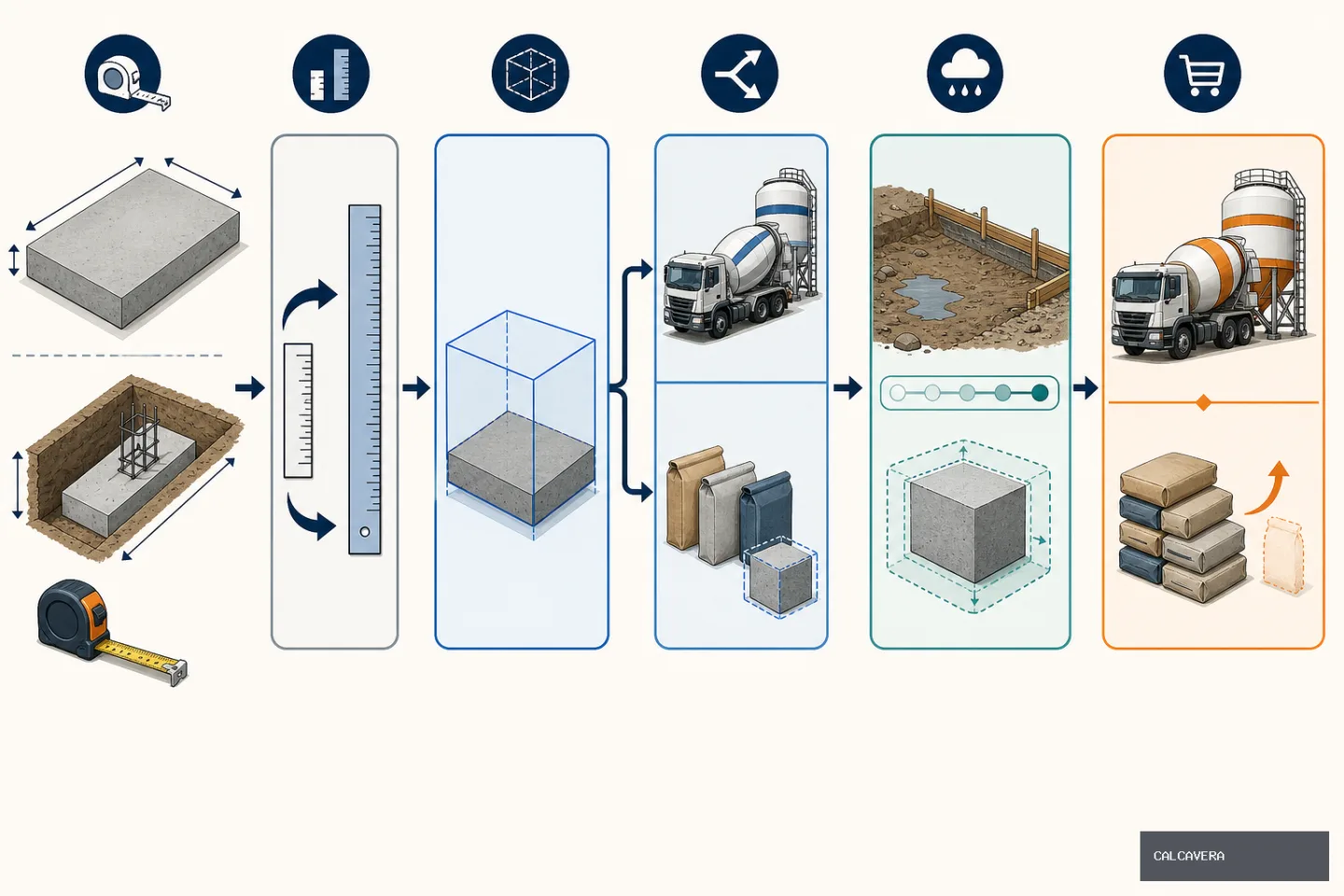
That gives you the theoretical volume. Your purchase or delivery quantity may need to be higher to account for excavation variation, placement losses and other site conditions. Keep those two numbers separate so you can see what you are calculating and why.
Use the Calcavera Concrete Slab Calculator to calculate your own slab volume, then use this guide to check dimensions, conversions and ordering assumptions.
Scope: This is a quantity guide, not a structural design guide. The example dimensions and thicknesses below illustrate arithmetic; they are not recommendations for a particular patio, driveway, garage slab or footing.
The basic concrete volume formula
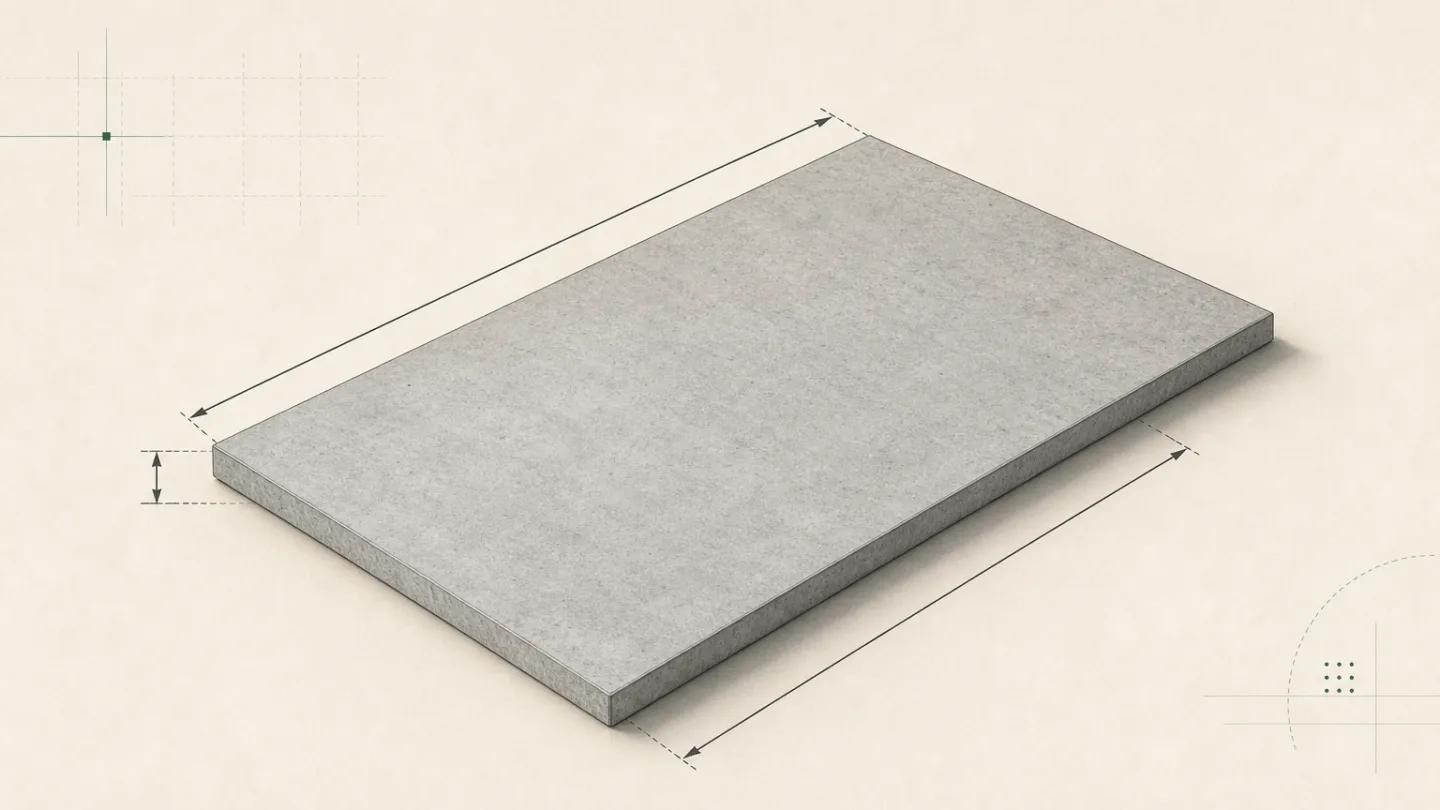
Concrete volume = length × width × thickness
For a footing, the third dimension is commonly called depth rather than thickness. The arithmetic is the same for a rectangular cross-section.
- Feet × feet × feet gives cubic feet.
- Meters × meters × meters gives cubic meters.
- Area × thickness also gives volume, provided the units are compatible.
A slab that measures 12 feet by 16 feet has an area of 192 square feet. That is not enough information to determine the concrete quantity: a 6-inch-thick slab needs 50% more concrete than a 4-inch-thick slab with the same area.
Convert inches to feet before multiplying
When length and width are in feet but thickness is in inches, divide thickness by 12 first:
Thickness in feet = thickness in inches ÷ 12
- 4 inches = 4 ÷ 12 = one-third of a foot.
- 6 inches = 6 ÷ 12 = 0.5 feet.
- 8 inches = 8 ÷ 12 = two-thirds of a foot.
- 12 inches = 1 foot.
The combined formula is:
Cubic feet = length in feet × width in feet × (thickness in inches ÷ 12)
Keep the full conversion in your calculation rather than rounding one-third of a foot to 0.33 too early.
Convert cubic feet to cubic yards
A cubic yard contains 27 cubic feet because 1 yard equals 3 feet and 3 × 3 × 3 = 27.
Cubic yards = cubic feet ÷ 27
For rectangular work measured in feet and inches, you can combine the steps:
Cubic yards = length in feet × width in feet × thickness in inches ÷ 324
This shortcut works because 12 × 27 = 324. Do not use it if your dimensions are in different units.
Metric concrete calculations and conversions
For metric calculations, convert all dimensions to meters before multiplying:
- Millimeters to meters: divide by 1,000.
- Centimeters to meters: divide by 100.
- Cubic meters to liters: multiply by 1,000.
- Cubic meters to cubic yards: multiply by approximately 1.30795.
- Cubic yards to cubic meters: multiply by approximately 0.764555.
- Cubic feet to cubic meters: multiply by 0.028316846592.
Metric example: A slab measuring 4 meters × 3 meters × 100 millimeters has a thickness of 0.1 meters. Its volume is 4 × 3 × 0.1 = 1.2 cubic meters, equivalent to 1,200 liters or approximately 1.57 cubic yards, before any allowance.
Do not divide cubic centimeters by 100 to obtain cubic meters. Volume conversions are cubed: 1 cubic meter equals 1,000,000 cubic centimeters.
Worked concrete quantity examples
The examples below assume simple rectangular shapes with uniform thickness or depth. Unless stated otherwise, quantities exclude any allowance and any additional thickened edges, beams or separate foundations.
1. Small concrete pad: 4 × 4 feet, 4 inches thick
- Convert thickness: 4 ÷ 12 = one-third of a foot.
- Calculate volume: 4 × 4 × (4 ÷ 12) = 5.333 cubic feet.
- Convert to yards: 5.333 ÷ 27 = approximately 0.198 cubic yards.
Theoretical quantity: approximately 5.33 cubic feet. This is a useful scale for comparing bagged products by their documented yield.
2. Patio slab: 12 × 16 feet, 4 inches thick
Volume = 12 × 16 × (4 ÷ 12) = 64 cubic feet
Cubic yards = 64 ÷ 27 = approximately 2.37 cubic yards
When estimating concrete for a patio, measure the actual planned footprint. Split an L-shaped patio into non-overlapping rectangles and add their volumes. If a plan specifies a thickened perimeter, calculate the extra depth separately rather than treating the whole patio as uniformly thicker.
3. Driveway section: 10 × 20 feet, 6 inches thick
Volume = 10 × 20 × (6 ÷ 12) = 100 cubic feet
Cubic yards = 100 ÷ 27 = approximately 3.70 cubic yards
For this same footprint at 4 inches thick, the theoretical volume would be approximately 2.47 cubic yards. That comparison shows how strongly thickness affects quantity; it does not establish which thickness is suitable for the driveway.
Measure separate driveway sections where width or thickness changes. Do not assume one average thickness is accurate when the design includes substantial variations.
4. Rectangular footing: 20 feet long, 18 inches wide, 12 inches deep
Convert both cross-section dimensions: 18 inches = 1.5 feet, and 12 inches = 1 foot.
Volume = 20 × 1.5 × 1 = 30 cubic feet
Cubic yards = 30 ÷ 27 = approximately 1.11 cubic yards
This calculation applies only to the stated rectangular footing. Include any separate stem wall, pier or other component in its own calculation. At intersecting footings, avoid counting the shared volume twice.
5. Multiple identical sections: five 3 × 5-foot pads, 4 inches thick
One pad = 3 × 5 × (4 ÷ 12) = 5 cubic feet
Five pads = 5 × 5 = 25 cubic feet
Total cubic yards = 25 ÷ 27 = approximately 0.93 cubic yards
Multiply by the number of sections only when their dimensions are identical. If they differ, calculate each size group separately, then add the results.
Concrete quantity table for example slabs
These are theoretical volumes for uniform rectangular slabs. Displayed values are rounded; calculate with unrounded values before applying an allowance. The thicknesses are examples, not construction specifications.
| Slab dimensions | Thickness | Cubic feet | Cubic yards |
|---|---|---|---|
| 4 × 4 feet | 4 inches | 5.33 | 0.20 |
| 8 × 10 feet | 4 inches | 26.67 | 0.99 |
| 10 × 12 feet | 4 inches | 40.00 | 1.48 |
| 12 × 16 feet | 4 inches | 64.00 | 2.37 |
| 12 × 16 feet | 6 inches | 96.00 | 3.56 |
| 10 × 20 feet | 6 inches | 100.00 | 3.70 |
| 20 × 20 feet | 4 inches | 133.33 | 4.94 |
| 20 × 20 feet | 6 inches | 200.00 | 7.41 |
Applying the method to common projects
- Patios and pads: calculate the footprint at the specified thickness. Add separately specified thickened portions.
- Sidewalks and walkways: calculate each straight rectangular section. For curves or changing widths, use measured areas or a suitable geometric breakdown, then multiply by thickness.
- Driveways: separate sections with different widths, thicknesses or details, and account for any specified additional concrete.
- Garage slabs: use the slab dimensions and thickness from the project documents. Calculate grade beams, thickened edges and other elements separately where applicable.
- Footings: use the specified length, width and depth. Check actual excavation dimensions before finalizing the order.
A concrete volume calculator handles arithmetic, but it cannot determine the correct structural dimensions from the project's name alone.
From theoretical volume to a practical order quantity
Ordering exactly the theoretical quantity can cause a shortage because that calculation assumes the forms, excavation and base match the measured geometry perfectly.
Real-world differences can include:
- Uneven excavation or trench overbreak.
- A base or subgrade that sits lower than expected.
- Variations in forms or finished dimensions.
- Spillage and concrete that does not reach the intended space.
- Placement arrangements that require additional planning with the supplier or pumping contractor.
Practical quantity = theoretical volume + an allowance appropriate to the project
If you express the allowance as a percentage:
Adjusted volume = theoretical volume × (1 + allowance percentage ÷ 100)
Illustration only: If a project team selects a 10% allowance for the 64-cubic-foot patio example, the adjusted volume is 64 × 1.10 = 70.4 cubic feet, or approximately 2.61 cubic yards. This demonstrates the calculation; 10% is not a universal recommendation.
The appropriate allowance depends on measurement accuracy, excavation, placement method and site conditions. Check the forms and base where possible, then discuss the order quantity, delivery increments and placement arrangements with the concrete supplier or contractor.
Correct known geometry before adding a general allowance. For example, a 20 × 20-foot slab that is actually half an inch deeper throughout needs an additional 20 × 20 × (0.5 ÷ 12) = 16.67 cubic feet, or approximately 0.62 cubic yards. A percentage allowance should not hide a measurable difference.
How many bags of concrete do I need?
Use the volume of mixed concrete produced by the specific product, not bag weight alone.
Number of bags = required concrete volume ÷ yield per bag
Round up to the next whole bag. Use the same volume unit for the project and the bag yield. Include any selected allowance in the required volume before dividing.
Documented bag yields
QUIKRETE's product information for Concrete Mix No. 1101 lists these approximate mixed-concrete yields:
| Specific product bag size | Approximate yield |
|---|---|
| 60-pound bag | 0.45 cubic feet |
| 80-pound bag | 0.60 cubic feet |
These figures apply to that product; they are not universal yields for every bagged concrete mix. Confirm the current packaging or manufacturer technical information for the exact product you will buy, and follow its mixing instructions.
Bag calculation for the small pad
The 4 × 4-foot pad at 4 inches thick has a theoretical volume of 5.333 cubic feet.
- Using the documented 80-pound yield: 5.333 ÷ 0.60 = 8.89, so 9 bags before an allowance.
- Using the documented 60-pound yield: 5.333 ÷ 0.45 = 11.85, so 12 bags before an allowance.
If a 10% allowance were selected for this example, the adjusted requirement would be approximately 5.867 cubic feet. At 0.60 cubic feet per bag, that is 9.78 bags, rounded up to 10 bags. Again, the percentage is an arithmetic illustration, not a default for every pad.
Ready-mix or bagged concrete?
Bagged concrete can be practical for small pads, limited-volume work or locations where delivery is difficult. Ready-mix often becomes more practical as the volume and need for coordinated placement increase.
For scale, the patio example requires 64 ÷ 0.60 = 106.67, or 107 of the specified 80-pound bags before an allowance. That is a substantial mixing and handling task even though the theoretical volume is only about 2.37 cubic yards.
Compare the options using:
- Total volume and the resulting bag count.
- Available labor, mixing equipment and placement rate.
- Truck access and the route from delivery to the forms.
- Supplier minimums, delivery terms and scheduling.
- Whether pumping or another placement arrangement is needed.
- The project's specified concrete properties and construction requirements.
There is no universal volume at which ready-mix becomes the better choice. Discuss the project with the supplier before committing to an order or delivery arrangement.
Reinforcement, soil and design: what volume calculations do not decide
For ordinary quantity estimates, rebar or reinforcing mesh is normally not deducted from the gross slab or footing volume. Reinforcement still requires separate planning for quantities, layout, supports and placement according to the project design.
Significant formed voids, blockouts or unusual embedded components may need separate treatment. Do not make deductions merely because the slab contains conventional reinforcing steel.
Soil conditions, intended loads, structural design and local building requirements can affect slab thickness, footing dimensions, reinforcement and other details. Those decisions must come from the applicable plans, qualified advice and local requirements—not from a quantity calculator.
Common concrete calculation mistakes
- Forgetting to convert inches to feet: multiplying a 10 × 12-foot slab by 4 instead of 4 ÷ 12 produces a result 12 times too large.
- Confusing area with volume: 120 square feet is not 120 cubic feet. Thickness is still needed.
- Forgetting multiple sections: a correct calculation for one pad is incomplete if you need five.
- Missing extra concrete: thickened edges, steps, beams and separate footings may not be included in a simple slab calculation.
- Double-counting intersections: overlapping rectangular sections can inflate the total.
- Ordering exactly the theoretical quantity: ideal geometry does not account for all actual site conditions.
- Assuming a bag yield: use the selected product's documented yield, not a figure remembered from a different mix.
- Rounding too early: retain calculation precision, then round the final purchase quantity appropriately.
A practical concrete quantity checklist
- Confirm the project dimensions and specified thickness or footing depth.
- Break the work into simple, non-overlapping sections.
- Convert every dimension to compatible units.
- Calculate each volume and add the sections.
- Convert the total to cubic yards, cubic meters or the unit required for purchasing.
- Check actual forms, excavation and base conditions.
- Select an appropriate allowance and document its basis.
- For bags, divide by the verified product yield and round up. For ready-mix, confirm the practical order quantity with the supplier.
Start with the Calcavera Concrete Slab Calculator for the arithmetic, then check the result against the real project. A useful estimate combines accurate measurements, correct units and a deliberate ordering decision.
Technical references and product information
- QUIKRETE, Concrete Mix No. 1101: manufacturer product information and technical data for the approximate bag yields used above. Product page: https://www.quikrete.com/productlines/concretemix.asp. Verify the current product information before purchasing.
- National Ready Mixed Concrete Association, CIP 31: Ordering Ready Mixed Concrete: practical guidance on communicating project requirements and arranging a ready-mix order.
- American Concrete Institute, ACI 332: Code Requirements for Residential Concrete: a technical reference for residential concrete design and construction requirements, distinct from the volume arithmetic in this guide. Applicable requirements and editions depend on the project and jurisdiction.
The worked examples are geometric calculations, not quoted construction specifications. No example allowance or slab thickness is presented as a universal requirement.
Frequently asked questions
How do I calculate how much concrete I need?
For a rectangular slab, multiply length × width × thickness using compatible units. If all dimensions are in feet, the result is cubic feet; divide by 27 to get cubic yards. If all dimensions are in meters, the result is cubic meters. Calculate each distinct section separately, add the volumes, then decide on an appropriate allowance for actual site conditions.
How much concrete do I need for a 10 × 12-foot slab?
At an illustrative thickness of 4 inches, a 10 × 12-foot slab needs 10 × 12 × (4 ÷ 12) = 40 cubic feet, or approximately 1.48 cubic yards, before any allowance. At 6 inches thick, the same slab needs 60 cubic feet, or approximately 2.22 cubic yards. These thicknesses are calculation examples, not design recommendations.
How many bags of concrete do I need?
Divide the required concrete volume by the mixed-concrete yield stated for the specific bagged product, then round up to a whole bag. For example, QUIKRETE Concrete Mix No. 1101 lists an approximate yield of 0.60 cubic feet for an 80-pound bag. A project requiring 5.33 cubic feet would therefore need 9 bags before any additional allowance. Verify the current product information before purchasing.
How much extra concrete should I order?
There is no universally correct percentage. Consider measurement accuracy, excavation irregularities, subgrade variation, placement losses and the supplier's ordering increments. A carefully formed slab may need a different allowance from a footing poured against uneven earth. Calculate the theoretical volume first, then agree on a practical order quantity with the contractor or supplier.
Is slab area enough to calculate concrete?
No. Square feet or square meters describe area, not volume. You must multiply the area by slab thickness, expressed in a compatible unit, to determine the concrete quantity.
Should I subtract rebar from the concrete volume?
For ordinary slab and footing quantity estimates, rebar and mesh are normally not deducted from the gross concrete volume. Reinforcement still affects design, placement and purchasing. Significant formed voids or unusual embedded components may need separate treatment by the project designer or estimator.
When is ready-mix more practical than bagged concrete?
Ready-mix often becomes more practical when the required volume would mean handling and mixing many bags, or when placement needs to proceed continuously. The decision also depends on access, delivery terms, mixing equipment, labor and placement arrangements. There is no single volume threshold that works for every project.
Can I use the same calculation for footings and multiple pads?
Yes. For a rectangular footing, multiply its length × width × depth after converting all measurements to compatible units. For identical pads, calculate one pad and multiply by the number of pads. Include separately specified thickened edges or other additional volumes, and avoid double-counting overlapping sections.