
On this page
- Quick answer: how many bags of concrete do I need?
- Concrete bag yields: use the product, not just the weight
- How to calculate your concrete bag count
- Concrete bag comparison table
- Worked examples: slabs, pads, posts and footings
- How many 80 lb, 60 lb or 40 lb bags do I need?
- How many bags of concrete are in one cubic yard?
- When ready-mix may be more practical
- Common concrete bag estimating mistakes
- Manufacturer sources and product checks
Quick answer: how many bags of concrete do I need?
The number of bags depends on your project volume, the bag size, and the documented yield of the specific concrete product. Divide the required volume by the yield per bag, then round upward to a whole bag.
Number of bags = Required concrete volume ÷ Yield per bag
For example, if you need 6 cubic feet and your chosen product yields 0.60 cubic feet per bag, you need 6 ÷ 0.60 = 10 bags before any allowance.
Use the Calcavera Concrete Bags Calculator to work out your quantity. Check the yield printed on the bag or in the manufacturer's official technical data first: bags of the same weight do not necessarily produce the same concrete volume.
Concrete bag yields: use the product, not just the weight
The main examples below use the approximate yields documented for QUIKRETE Concrete Mix No. 1101. These are product-specific planning values, not universal yields for all bagged concrete.
| Bag size | Documented approximate yield | Bags per cubic foot, before rounding |
|---|---|---|
| 40 lb | 0.30 cubic feet | 3.33 |
| 60 lb | 0.45 cubic feet | 2.22 |
| 80 lb | 0.60 cubic feet | 1.67 |
For exactly 1 cubic foot, these calculations round upward to 4, 3, or 2 bags respectively. For larger projects, calculate from the total volume rather than multiplying these already-rounded counts.
Why equal bag weights can give different answers
CTS Cement documents approximately 0.50 cubic feet per 60 lb bag of Rapid Set Concrete Mix, compared with approximately 0.45 cubic feet for a 60 lb bag of QUIKRETE Concrete Mix No. 1101. For a 6-cubic-foot project, those yields mean 12 bags versus 14 bags before an allowance. They are different products, so also check their application and mixing instructions; do not choose on yield alone.
What about 50 lb and metric bags?
If your chosen product comes in a 50 lb bag, use its published yield rather than interpolating from another product's 40 lb or 60 lb bag. The same rule applies to 20 kg, 25 kg and 30 kg bags: there is no universal mixed yield for each weight.
For a metric product that lists yield in liters, convert your required cubic meters to liters by multiplying by 1,000. Then divide by the stated liters per bag and round upward.
How to calculate your concrete bag count
- Calculate project volume. For a rectangular pour, multiply length × width × depth. For a cylindrical hole, use π × radius² × depth. Use consistent units.
- Match the yield unit. Convert cubic yards to cubic feet by multiplying by 27, or cubic meters to liters by multiplying by 1,000, when needed.
- Consider an allowance. If appropriate, increase the volume for uneven excavation, spillage, or measurement uncertainty.
- Divide by the documented yield per bag. Do not divide cubic feet by a yield stated in liters.
- Round the final result upward. A result of 13.2 means buying 14 whole bags.
Bags with allowance = Round upward [Volume × (1 + allowance) ÷ Yield per bag]
A 10% allowance is used in some examples below to illustrate the method. It is not a construction standard or a universal recommendation. Choose an allowance that reflects the actual site conditions.
This guide focuses on bag quantities. For broader estimating, consult Calcavera's How Much Concrete Do I Need? Complete Slab, Footing & Bag Guide. For detailed slab measurements, use How to Calculate Concrete for a Slab: Cubic Yards & Volume Guide and the Concrete Slab Calculator.
Concrete bag comparison table
These estimates use the QUIKRETE Concrete Mix No. 1101 yields above. Counts are rounded upward and exclude an additional waste allowance. Project dimensions are calculation examples, not recommended structural dimensions.
| Project | Concrete volume | 40 lb bags | 60 lb bags | 80 lb bags |
|---|---|---|---|---|
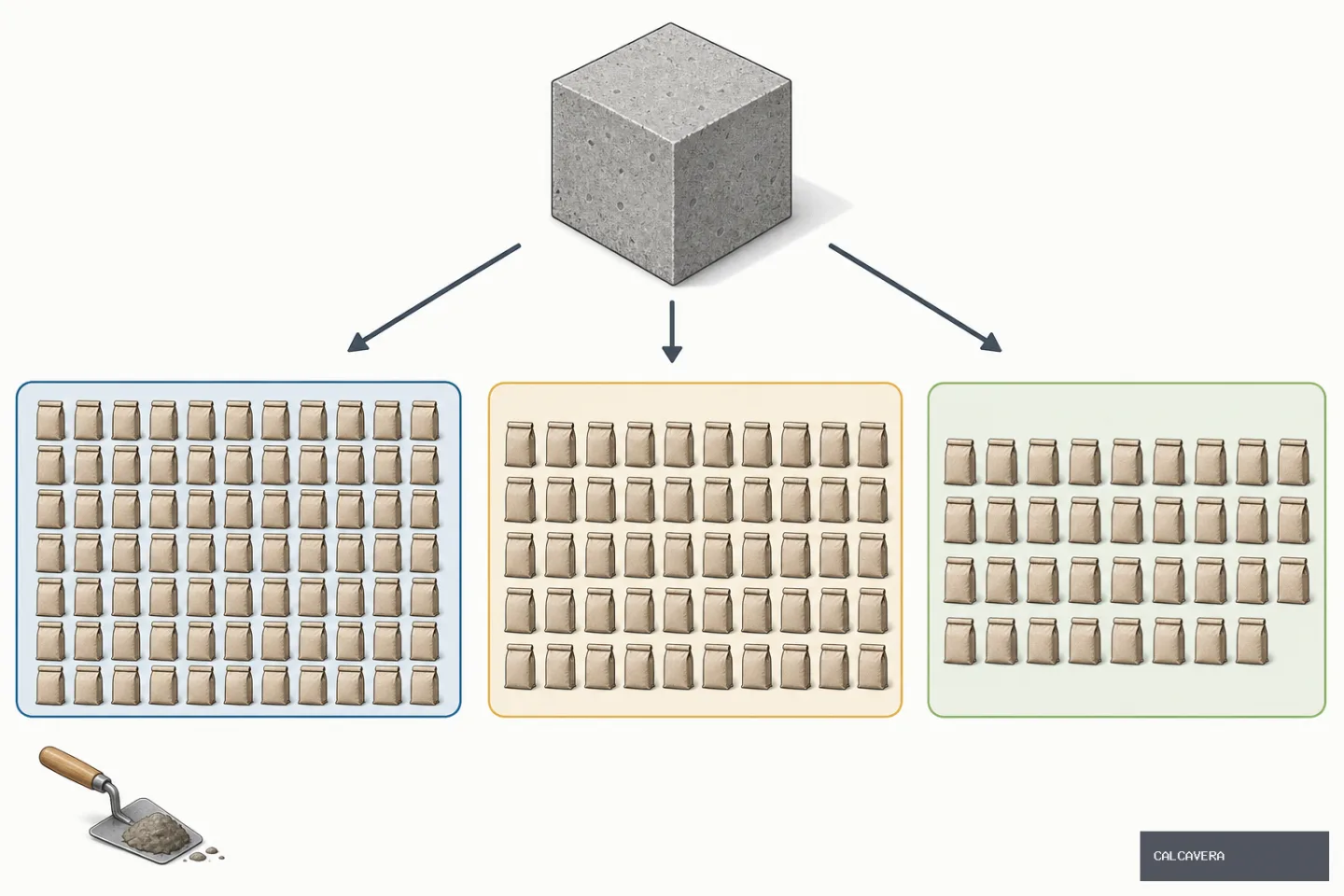
| 1 cubic foot | 1.00 cubic feet | 4 | 3 | 2 |
| 2 ft × 2 ft × 1 ft footing | 4.00 cubic feet | 14 | 9 | 7 |
| 4 ft × 6 ft pad, 4 inches thick | 8.00 cubic feet | 27 | 18 | 14 |
| 10 ft × 10 ft slab, 4 inches thick | 33.33 cubic feet | 112 | 75 | 56 |
| One post hole, net volume described below | About 1.401 cubic feet | 5 | 4 | 3 |
| Ten identical post holes, net volume | About 14.007 cubic feet | 47 | 32 | 24 |
| 1 cubic yard | 27.00 cubic feet | 90 | 60 | 45 |
Displayed volumes are rounded for readability. Keep full precision during your calculation and round only the final bag count.
Worked examples: slabs, pads, posts and footings
How many bags of concrete for a 10x10 slab?
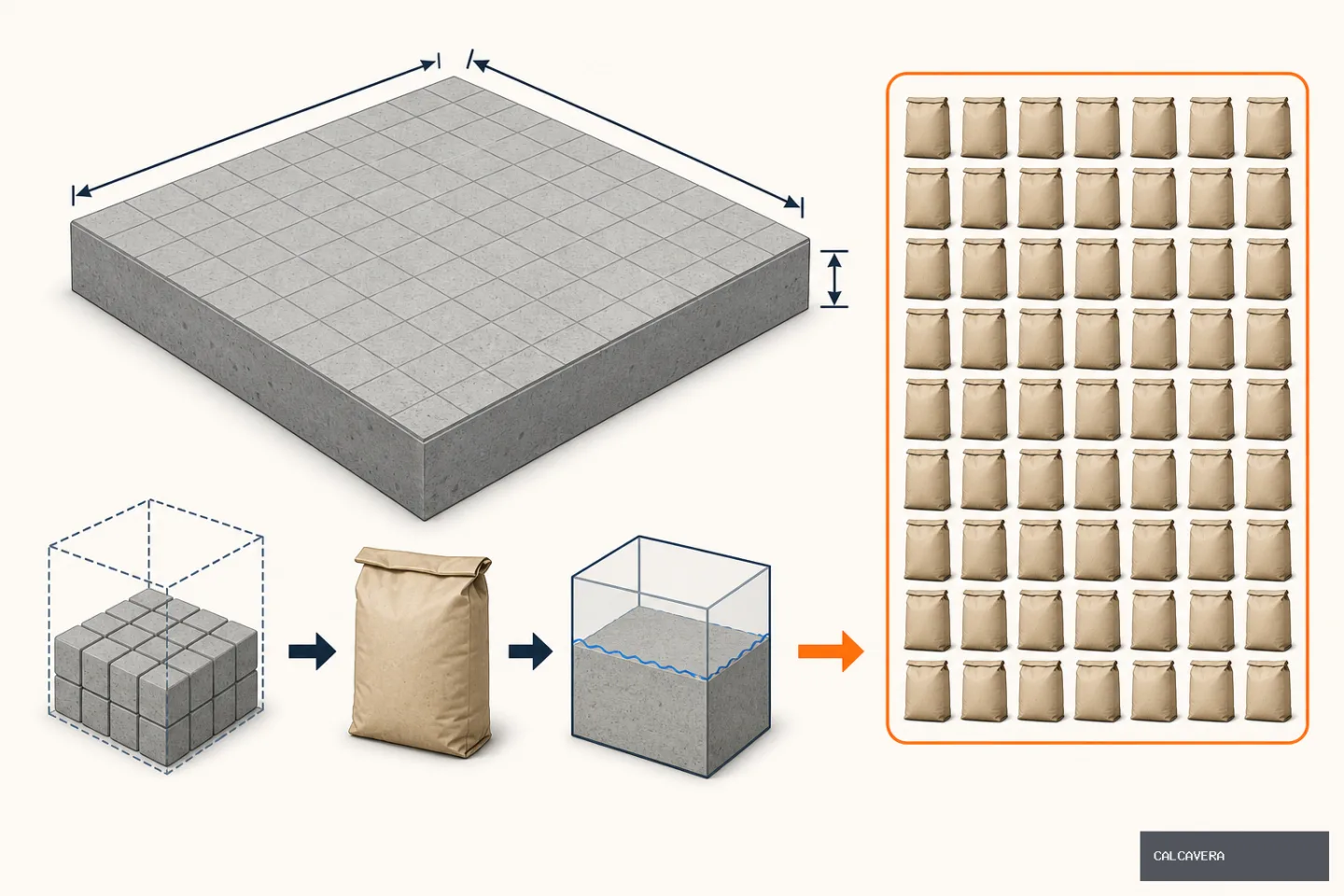
Assume a slab measuring 10 ft × 10 ft × 4 inches thick. Convert the thickness first: 4 ÷ 12 = one-third of a foot.
Volume = 10 × 10 × (4 ÷ 12) = 33.333… cubic feet.
- 40 lb bags: 33.333… ÷ 0.30 = 111.111… → 112 bags.
- 60 lb bags: 33.333… ÷ 0.45 = 74.074… → 75 bags.
- 80 lb bags: 33.333… ÷ 0.60 = 55.555… → 56 bags.
With an illustrative 10% allowance, the planning volume becomes 36.666… cubic feet. That requires 123 bags of 40 lb, 82 bags of 60 lb, or 62 bags of 80 lb. A different slab thickness changes every result.
A small patio or equipment pad
For a 4 ft × 6 ft pad at 4 inches thick, volume is 4 × 6 × (4 ÷ 12) = 8 cubic feet.
Using 80 lb bags at 0.60 cubic feet each: 8 ÷ 0.60 = 13.333… → 14 bags. The corresponding counts are 18 bags of 60 lb or 27 bags of 40 lb.
If you add 10% before dividing, the volume becomes 8.8 cubic feet. You would need 15 bags of 80 lb, 20 bags of 60 lb, or 30 bags of 40 lb.
How many bags of concrete for a fence post?
Assume a cylindrical hole 12 inches in diameter and 24 inches deep, with a square post measuring 3.5 inches across occupying the full 24-inch depth. These are arithmetic assumptions, not post-setting recommendations.
- Convert dimensions: hole radius = 0.5 ft; concrete depth = 2 ft.
- Calculate gross hole volume: π × 0.5² × 2 ≈ 1.571 cubic feet.
- Subtract the embedded post volume: (3.5 ÷ 12)² × 2 ≈ 0.170 cubic feet.
- Net concrete volume ≈ 1.571 − 0.170 = 1.401 cubic feet.
- Divide by 80 lb bag yield: approximately 1.401 ÷ 0.60 = 2.33… → 3 bags.
The same net volume requires 4 bags of 60 lb or 5 bags of 40 lb. Use the actual concrete-filled depth if the hole includes a separate gravel layer, and measure the post rather than relying on its nominal size. An irregular or widened hole can require more material.
Multiple identical fence posts
For 10 holes matching the previous example, multiply the unrounded net volume by 10: approximately 14.007 cubic feet.
Using 80 lb bags: 14.007 ÷ 0.60 ≈ 23.34 → 24 bags before an allowance. With 10% added to the volume, the count becomes 26 bags.
Do not automatically multiply the rounded three-bag estimate for one hole by ten. Calculate the combined volume first when unused mix can be allocated across holes. If the holes differ in size, estimate them separately and add their volumes.
A small footing
For an example footing measuring 2 ft × 2 ft × 1 ft, volume is 2 × 2 × 1 = 4 cubic feet.
At 0.60 cubic feet per 80 lb bag, 4 ÷ 0.60 = 6.666… → 7 bags. Using 60 lb bags gives 9 bags; using 40 lb bags gives 14 bags.
With a 10% allowance, use 4.4 cubic feet: 8 bags of 80 lb, 10 bags of 60 lb, or 15 bags of 40 lb. Use the Calcavera Concrete Footing Calculator for the volume stage. Footing dimensions must come from the project requirements, not this quantity example.
Ready to estimate your purchase? Enter your volume and chosen product yield into the Calcavera Concrete Bags Calculator, then apply an appropriate allowance before rounding up.
How many 80 lb, 60 lb or 40 lb bags do I need?
How many 80 lb bags of concrete do I need?
For QUIKRETE Concrete Mix No. 1101, divide the required cubic feet by 0.60. For example, 12 ÷ 0.60 = 20 bags before an allowance.
How many 60 lb bags of concrete do I need?
For the same QUIKRETE product, divide cubic feet by 0.45. A 12-cubic-foot project requires 12 ÷ 0.45 = 26.666… → 27 bags. Do not apply that yield to a different 60 lb product without checking its data.
How many 40 lb bags of concrete do I need?
For the same QUIKRETE product, divide cubic feet by 0.30. A 12-cubic-foot project requires 12 ÷ 0.30 = 40 bags.
How many bags of concrete are in one cubic yard?
There is no universal number of concrete bags per cubic yard without specifying the product and yield. One cubic yard equals 27 cubic feet.
Using the QUIKRETE Concrete Mix No. 1101 yields:
- 40 lb: 27 ÷ 0.30 = 90 bags.
- 60 lb: 27 ÷ 0.45 = 60 bags.
- 80 lb: 27 ÷ 0.60 = 45 bags.
With an illustrative 10% allowance, those counts become 99, 66 and 50 bags respectively. By comparison, the documented 0.50-cubic-foot yield for a 60 lb Rapid Set Concrete Mix bag gives 27 ÷ 0.50 = 54 bags before an allowance.
When ready-mix may be more practical
As bag counts grow, evaluate the work involved rather than using a fixed size cutoff. The 10x10 slab example needs 56 bags of 80 lb before an allowance: 4,480 lb of dry bagged material to transport and handle, followed by mixing and placement.
- Mixing capacity: How many batches can your equipment handle, following its instructions?
- Crew and placement: Can you mix, move and place the concrete at a pace suited to the product and pour?
- Access: Can a delivery truck reach the site, or would additional placement equipment be needed?
- Local terms: Compare delivered pricing, minimum quantities, scheduling and any applicable charges.
- Project staging: Separate post holes may suit bagged mixing better than a large continuous pour.
Ask a local ready-mix supplier for a project-specific comparison when the handling or batch count looks impractical.
Common concrete bag estimating mistakes
- Assuming identical yield for equal bag weights. Check the exact brand and product.
- Using square feet instead of cubic volume. Area alone does not tell you how much concrete is required.
- Forgetting slab thickness. Include depth in every volume calculation.
- Leaving inches unconverted. Four inches is 4 ÷ 12 feet, not 4 feet.
- Rounding down. Always round the final bag quantity upward.
- Missing repeated holes or sections. Add all required volumes before calculating the combined purchase.
- Using a generic estimated yield. Manufacturer technical data for the exact product takes priority over a general table.
- Rounding too early. Retain full precision until the final bag count, especially for repeated holes.
Manufacturer sources and product checks
The main yield table and worked examples use QUIKRETE Concrete Mix No. 1101. The alternative 60 lb yield comes from CTS Cement's Rapid Set Concrete Mix information. Consult the latest applicable technical data and your bag's instructions before buying or mixing.
- QUIKRETE Concrete Mix product page: https://www.quikrete.com/productlines/concretemix.asp
- QUIKRETE Concrete Mix No. 1101 technical data: https://www.quikrete.com/pdfs/data_sheet-concrete%20mix%201101.pdf
- CTS Cement Rapid Set Concrete Mix product information: https://www.ctscement.com/product/concrete-mix
Published yields are approximate. Do not add extra water to try to increase yield; follow the selected product's mixing instructions.
Frequently asked questions
How many 80 lb bags make a cubic yard?
For QUIKRETE Concrete Mix No. 1101, the documented yield of an 80 lb bag is approximately 0.60 cubic feet. One cubic yard is 27 cubic feet, so 27 ÷ 0.60 = 45 bags before any waste allowance. Check your specific product: bag weight alone does not establish yield.
How many bags do I need for a 10x10 slab?
At 4 inches thick, a 10 ft × 10 ft slab requires approximately 33.33 cubic feet. Using QUIKRETE Concrete Mix No. 1101 yields, that is 112 bags of 40 lb, 75 bags of 60 lb, or 56 bags of 80 lb before an allowance. With an illustrative 10% allowance, the counts become 123, 82, or 62 bags respectively.
How many bags do I need for one fence post?
It depends on the hole dimensions, the portion occupied by the post, and the bag yield. A cylindrical hole 12 inches across and 24 inches deep, containing a square post measuring 3.5 inches across throughout that depth, requires approximately 1.401 cubic feet of concrete. That rounds up to three 80 lb bags of QUIKRETE Concrete Mix No. 1101 before an allowance.
Is 60 lb or 80 lb concrete better for estimating?
Neither is inherently more accurate. Estimate using the documented yield of the product you plan to buy. Larger bags generally mean fewer bags to handle, while smaller bags may be easier to lift and portion into your mixer. Compare total bags, total weight, and your mixing capacity.
Should I add extra concrete bags for waste?
Consider an allowance for spillage, irregular excavation, and small dimensional errors. A 10% allowance can be used as a planning example, but it is not a universal requirement. Apply your chosen allowance to the volume before dividing by bag yield and rounding upward.
How much concrete does one bag make?
Check the product's stated mixed yield. QUIKRETE Concrete Mix No. 1101 lists approximately 0.30 cubic feet for a 40 lb bag, 0.45 cubic feet for a 60 lb bag, and 0.60 cubic feet for an 80 lb bag. Those figures should not be assumed for every brand or mix.
When should I order ready-mix instead of bags?
Consider ready-mix when the bag count, lifting, mixing cycles, and placement time become difficult to manage. Compare local delivery terms and access with your crew, mixer capacity, and pour plan. There is no universal project-size cutoff.
How do I estimate concrete using 20 kg, 25 kg, or 30 kg bags?
Use the manufacturer's documented yield in liters or cubic meters. Convert the project volume into that same unit, divide by the yield per bag, and round upward. Do not assign a universal yield based only on the bag's kilogram weight.