
On this page
- Quick answer: how much gravel do I need under a concrete slab?
- Calculate gravel base volume
- Gravel base volume table for common slab sizes
- Worked examples
- Loose volume, compacted volume and delivered quantity
- Convert gravel volume to weight
- Which base material should you estimate?
- Is gravel needed under concrete?
- Before you order: a practical checklist
- Technical references and limits
Quick answer: how much gravel do I need under a concrete slab?
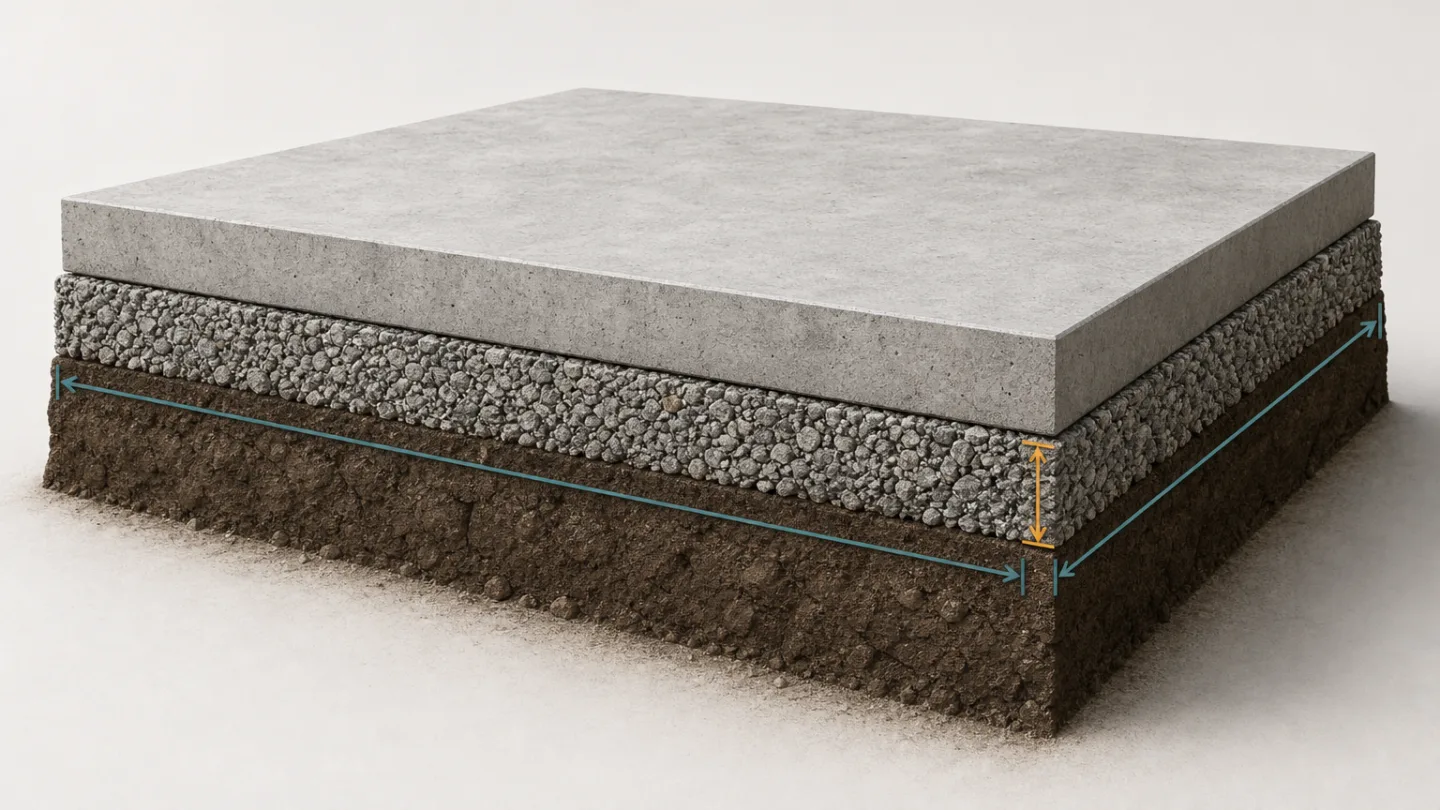
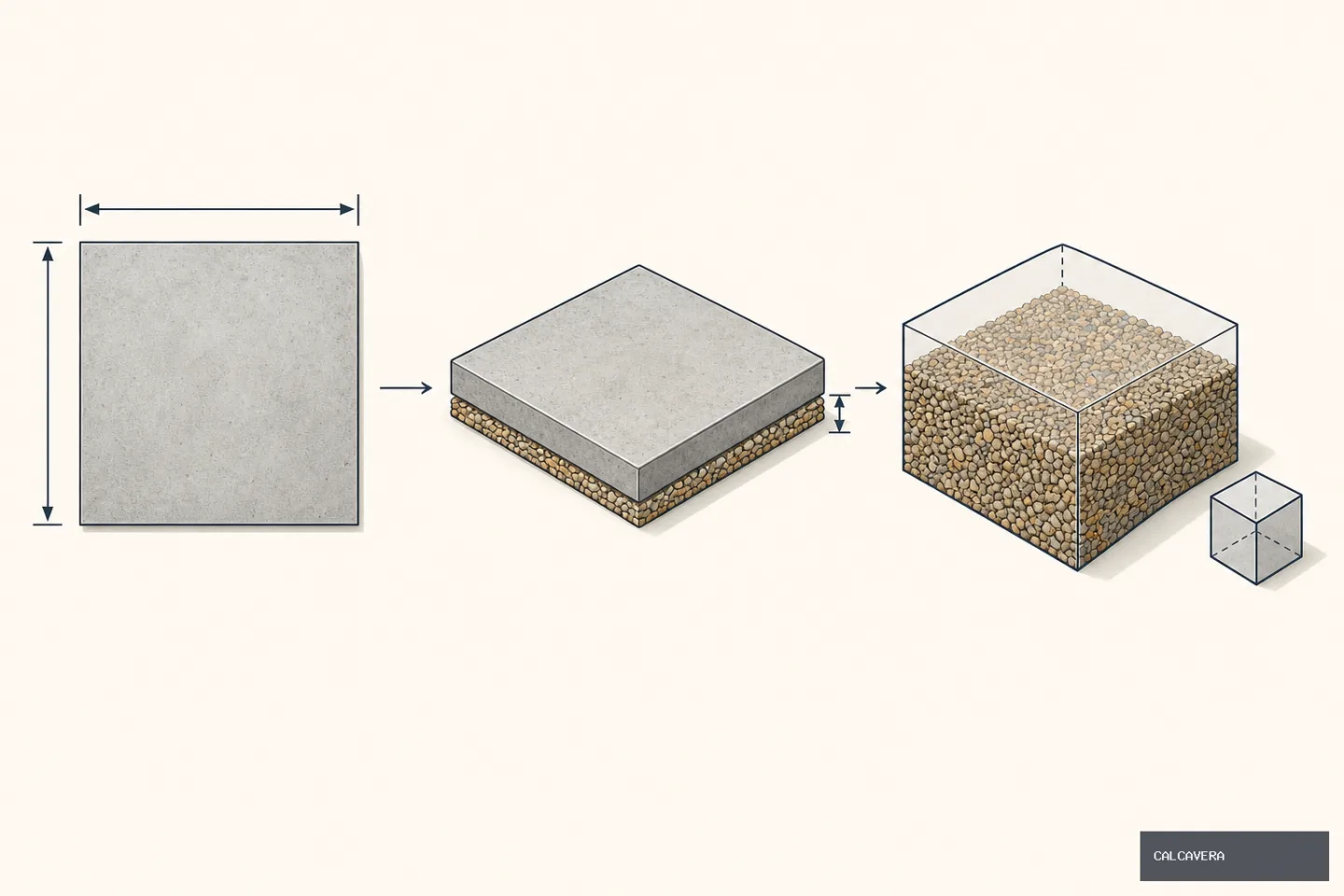
Multiply the base length × width × depth to find its volume. For measurements in feet, divide the result by 27 to get cubic yards. Convert a base depth measured in inches to feet first.
For example, a 10 ft × 10 ft base at 4 inches deep occupies approximately 1.23 cubic yards. If 4 inches is the required finished compacted depth, that figure describes the compacted base—not necessarily the loose quantity to order.
Your purchase quantity depends on the base footprint, planned depth, material condition and density, and actual ground conditions. Use the Calcavera Gravel Calculator to calculate the geometric volume, then confirm the ordering conversion with your supplier.
The depths in this guide are calculation examples, not construction requirements. Appropriate base depth depends on soil, drainage, loading, climate, project design and local requirements. This guide estimates material; it does not design the slab or determine whether the ground is suitable.
The size table and technical references use US conventions. Metric formulas and a worked example are also included. Outside the US, use your project's local aggregate specification and confirm the supplier's units: cubic meters and metric tonnes are not interchangeable with cubic yards and US short tons.
Calculate gravel base volume
Imperial measurements: feet, inches and cubic yards
Base volume in cubic feet = length in feet × width in feet × depth in feet
Depth in feet = depth in inches ÷ 12
Base volume in cubic yards = cubic feet ÷ 27
Combining those steps gives a useful shortcut:
Cubic yards = length in feet × width in feet × depth in inches ÷ 324
Round the displayed estimate as needed, but retain unrounded numbers when adding several sections.
Metric measurements: meters and cubic meters
Base volume in cubic meters = length in meters × width in meters × depth in meters
Convert millimeters to meters by dividing by 1,000, or centimeters to meters by dividing by 100. A 100 mm base is 0.10 m deep—not 100 m.
Measure the base footprint, not just the concrete footprint
If the project detail requires the base to extend beyond the slab edges, use those larger base dimensions. Include separate pads, approaches or other base areas only where they are part of the actual work.
For irregular shapes, split the footprint into manageable sections. Calculate each section separately and add the volumes without counting overlapping areas twice. Where depths differ, calculate those areas separately rather than applying one depth to the whole site. Slab thickness and base thickness are separate measurements.
Gravel base volume table for common slab sizes
The table shows approximate geometric volume in cubic yards, assuming the base matches the stated footprint and has a uniform depth. If the depth is a finished compacted depth, these are compacted volumes before any loose-material conversion or site allowance.
| Base footprint | Area | 2-inch depth | 3-inch depth | 4-inch depth | 6-inch depth |
|---|---|---|---|---|---|
| 8 ft × 10 ft | 80 sq ft | 0.49 yd³ | 0.74 yd³ | 0.99 yd³ | 1.48 yd³ |
| 10 ft × 10 ft | 100 sq ft | 0.62 yd³ | 0.93 yd³ | 1.23 yd³ | 1.85 yd³ |
| 12 ft × 20 ft | 240 sq ft | 1.48 yd³ | 2.22 yd³ | 2.96 yd³ | 4.44 yd³ |
| 12 ft × 40 ft | 480 sq ft | 2.96 yd³ | 4.44 yd³ | 5.93 yd³ | 8.89 yd³ |
Moving from a 3-inch to a 6-inch base doubles the calculated volume for the same footprint.
Worked examples
A 12 ft × 20 ft patio slab with a 3-inch base
Area = 12 × 20 = 240 square feet. Depth = 3 ÷ 12 = 0.25 feet.
240 × 0.25 = 60 cubic feet; 60 ÷ 27 = 2.22 cubic yards.
If the project instead specifies 4 inches of base, the volume becomes 240 × 4 ÷ 324 = approximately 2.96 cubic yards.
A 3 m × 4 m slab with a 100 mm base
Convert the depth: 100 ÷ 1,000 = 0.10 m.
3 × 4 × 0.10 = 1.20 cubic meters.
If the required base depth is 150 mm instead, the volume is 3 × 4 × 0.15 = 1.80 cubic meters.
Loose volume, compacted volume and delivered quantity
These terms describe different parts of the estimate:
- Compacted volume: the space occupied by the finished base after placement and specified compaction.
- Loose volume: the space occupied by aggregate before that compaction, such as loose material in a stockpile or delivery body.
- Delivered quantity: the purchased amount, quoted by loose volume, weight or another clearly defined supplier measure.
As aggregate is placed and compacted, particles rearrange and the occupied volume can decrease. You may therefore need more loose material than the final compacted volume. The relationship depends on aggregate type, grading, moisture condition and placement method.
There is no universal compaction multiplier. Do not automatically add a percentage copied from an unrelated material or project. Ask the supplier or contractor for a conversion appropriate to the exact product and specified finished condition.
If a supplier provides a documented loose-volume multiplier, use:
Estimated loose volume = required compacted volume × supplier-specific multiplier
Keep site allowances separate. A deeper excavation, a wider base footprint and material lost during handling are not the same thing as compaction. Also check whether the supplier's estimate already includes those allowances.
Check the excavation before finalizing the order
Measure from the prepared subgrade to the planned top of the base at several locations. A nominal depth can underestimate quantity when the excavation is uneven.
For perspective, an additional average inch of base across a 12 ft × 20 ft area adds 240 × 1 ÷ 324 = approximately 0.74 cubic yards. Correct unacceptable grade variation rather than treating every low spot as something to fill without review.
Convert gravel volume to weight
Material weight = volume × bulk density
Bulk density includes the voids between aggregate particles. It is not the same as the density of the solid rock itself. Use supplier-specific bulk density or documented product data where available.
| Available information | Calculation | Result |
|---|---|---|
| Volume in cubic yards; density in pounds per cubic yard | Volume × density | Pounds |
| Volume in cubic yards; density in pounds per cubic yard | Volume × density ÷ 2,000 | US short tons |
| Volume in cubic yards; density in US short tons per cubic yard | Volume × density | US short tons |
| Volume in cubic meters; density in kilograms per cubic meter | Volume × density ÷ 1,000 | Metric tonnes |
For the patio example, if the supplier gives a suitable density in pounds per cubic yard, the weight calculation is 2.222… × that density ÷ 2,000 US short tons. Use this directly only if the density represents the same material condition as the calculated volume.
A loose bulk density should not be multiplied by a required compacted volume without resolving the volume difference first. You can either use a documented compacted bulk density for the specified condition or convert the compacted requirement to loose volume before applying loose bulk density.
There is no fixed tons-per-cubic-yard value that applies to every gravel product. Confirm whether the supplier means US short tons, long tons or metric tonnes, and whether its data account for the expected moisture condition.
Which base material should you estimate?
Product names vary by region. Request the aggregate designation or grading specification, not just a load of “gravel.”
| Material | What to check |
|---|---|
| Crushed stone | Crushed rock is available in different gradings, with or without fines. Confirm particle sizes, grading, intended use and placement requirements. |
| Crushed gravel | A gravel-derived product that has been processed by crushing. Check the actual grading and specification rather than assuming it matches a crushed-rock product. |
| Dense-graded aggregate or road base | Generally combines a range of particle sizes, including fines. It may be specified for a compacted base, but should not automatically be treated as a free-draining layer. |
| Clean stone | Generally contains little fine material. It may be used where the design calls for a drainage-oriented layer, but requires suitable support, separation and placement details. |
Suitable gravel or crushed stone under a concrete slab depends on drainage needs, compaction requirements, project specifications and local availability. An open-graded layer needs an appropriate drainage arrangement; empty spaces between stones alone do not guarantee that water can leave the site.
Choose the material before converting volume to weight, because different products can have different bulk densities and loose-to-compacted relationships.
Is gravel needed under concrete?
A properly specified granular base may help:
- Create a stable working surface for construction.
- Establish a consistent grade beneath the slab.
- Provide drainage where the material and overall drainage detail are appropriate.
- Reduce the influence of weak or variable subgrade where the project design provides for it.
- Support controlled placement and compaction during preparation.
These benefits are conditional. A gravel layer does not prevent all cracking or settlement, repair every unsuitable soil condition, or replace drainage and subgrade preparation.
Some slab designs permit placement on a properly prepared subgrade; others specify granular layers. Follow the project details and local requirements. If ground conditions differ from those anticipated, resolve that issue before using an estimate as an ordering instruction.
Before you order: a practical checklist
- Confirm the specified material and finished base depth.
- Measure the complete base footprint, including required extensions.
- Calculate each section's geometric volume and total the results.
- Check actual excavation levels and address unexpected ground conditions.
- Confirm whether delivery is sold by loose volume or weight, and in which units.
- Obtain the product-specific conversion or density needed for the order.
- Agree on any site allowance and delivery rounding without counting either twice.
When speaking to the supplier, give both the quantity and its basis: “I need this volume at the specified finished compacted depth, using this aggregate.” That is clearer than requesting an unexplained number of yards or tons.
Technical references and limits
The following US publications provide general background on slab construction, subgrade preparation and aggregate behavior; they are not automatically requirements for your project:
- American Concrete Institute, Guide to Concrete Floor and Slab Construction, ACI 302.1R-15, 2015.
- American Concrete Institute, Guide to Design of Slabs-on-Ground, ACI 360R-10, 2010.
- Federal Highway Administration, Geotechnical Aspects of Pavements, reference manual, FHWA NHI-05-037, 2006.
Use the editions, local standards and aggregate specifications adopted by your project. State DOT specifications may help identify US aggregate gradings where a project adopts them; elsewhere, consult the relevant local specifications. This guide does not extract a universal base depth, density or compaction allowance from these references. Its numeric examples are geometric calculations; ordering conversions should come from documented product data or project-specific guidance.
Frequently asked questions
How much gravel do I need under a 10x10 slab?
At a specified 4-inch base depth, a 10 ft × 10 ft footprint requires approximately 1.23 cubic yards geometrically. If that is the finished compacted depth, confirm the loose delivery quantity with your supplier.
How deep should gravel be under concrete?
Use the project's specified finished base depth. The appropriate thickness depends on soil, drainage, loading, climate and local requirements—not on the calculator.
Is 2 inches of gravel enough under concrete?
Not necessarily. The 2-inch depth in the table is a calculation example. Suitability depends on the project requirements, ground conditions and whether the specified aggregate can be placed and compacted at that thickness.
How many cubic yards of gravel do I need?
Multiply length in feet × width in feet × base depth in inches, then divide by 324. This gives geometric volume; resolve the loose-to-compacted conversion before ordering.
How do I convert gravel volume to tons?
Multiply volume by the supplier's bulk density using compatible units and the same loose or compacted condition. Confirm whether the supplier uses US short tons, long tons or metric tonnes.
Does gravel need to be compacted before pouring concrete?
Where a compacted granular base is specified, compact it before concrete placement. Follow the project requirements for equipment, lift thickness, moisture and acceptance; a smooth-looking surface alone does not establish adequate compaction.
What type of gravel is used under concrete?
Use the specified aggregate designation or grading, not just a product called gravel. Crushed stone, crushed gravel, dense-graded aggregate and clean stone have different drainage and placement characteristics.
Do all concrete slabs need a gravel base?
No. Some designs permit placement on a properly prepared subgrade; others require granular or additional layers. Follow the project details and applicable local requirements.
Should I order extra gravel for compaction?
Ask for a product-specific conversion from finished compacted volume to delivered quantity. Keep handling losses and other site allowances separate, and check whether the supplier has already included them.